Sunken Natural-Stone Floor: Causes and Repair
A sunken or uneven natural-stone floor is more than a trip hazard. What causes settlement, when is repair possible and when is relaying necessary?
DecoStone Natural Stone
Natural stone specialist · Amsterdam
Table of contents
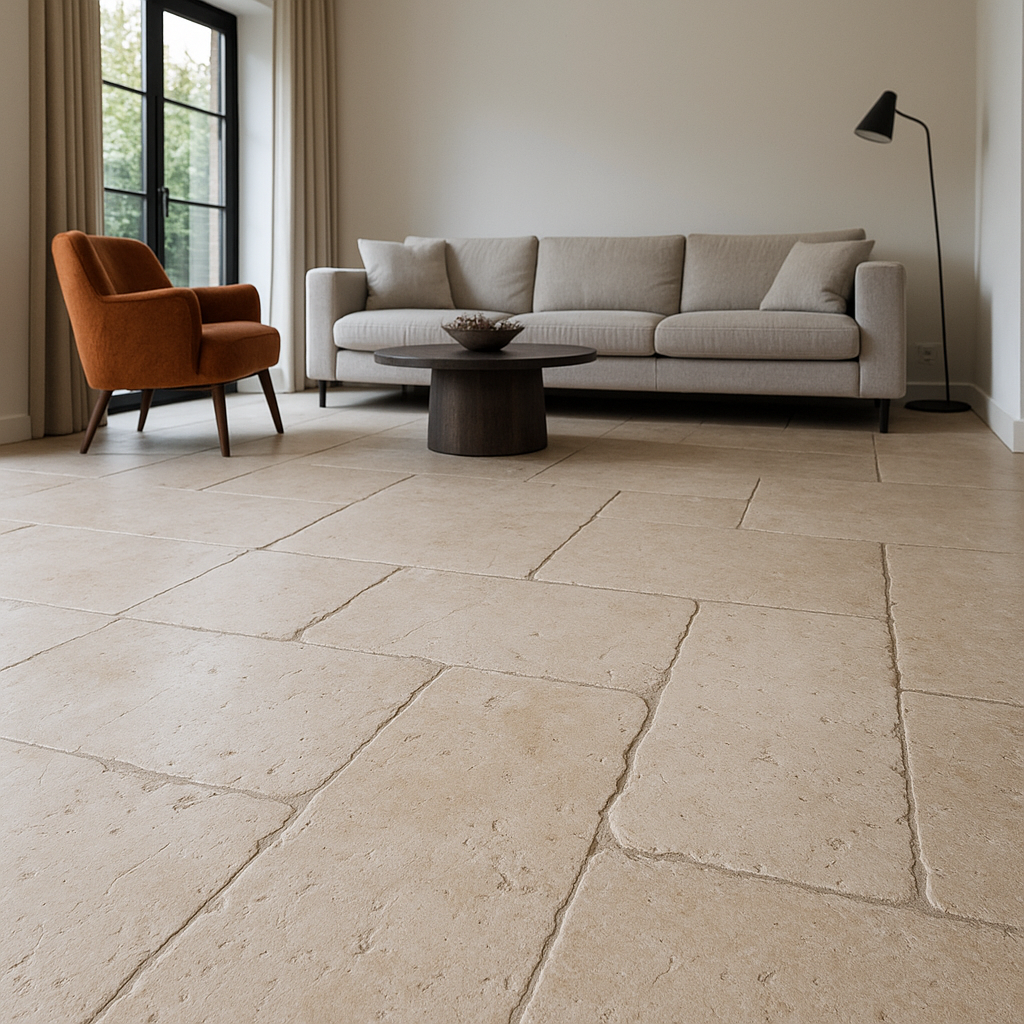
A floor that sinks: how do you notice it?
Settlement rarely starts dramatically. Usually it begins as a slight feeling of unevenness under your feet, a tile that sits a millimetre or so lower than its neighbours. A grout joint cracks. A click is heard when you walk over it.
Over time, the signs become stronger:
- Height differences between tiles become visible
- Loose tiles move when stepped on
- Cracks appear in tiles at regular intervals
- A hollow sound is heard when you tap certain tiles
- Jointing repeatedly cracks in the same place
If you recognise this, there is movement in your floor. The question is: where is it coming from?
Repair does not remove the cause
This is the first and most important truth about a sunken floor.
Putting a tile back, touching up a joint, rebonding a loose stone — these are useful actions if the substrate is stable. But if the cause of the settlement is not removed, everything you repair is temporary. The floor will move again. The tiles will come loose or crack again.
We regularly repair floors where a previous tradesperson disguised the problem without tackling the cause. That is not repair; it is postponement.
So always ask yourself first: why is this floor sinking? And only then: how do we approach it?
Causes of settlement
Uneven settlement of the substrate
Every subsoil settles over time. A crawl space that dries out, a clay layer that compresses, fill sand that has compacted unevenly. If the ground under the floor construction sinks, the floor will eventually follow.
You see this in older homes, extensions and floors where one side sinks faster than the other.
Hollow adhesive bed
A floor that looks good at first sight but sounds hollow has a problem in the adhesive bed. Air pockets or mortar that was not fully bedded create areas without support. Those areas break down or give way under load.
This is an installation fault that only becomes visible years later, often only when someone walks over it with heavy equipment.
Moving screed
A screed that moves because it is too thin, insufficiently reinforced or poorly bonded to the subfloor pulls the tiles along with it. This is especially relevant with heated floors: thermal expansion and contraction are daily loads.
Moisture under the floor
Moisture in the screed or substrate softens the adhesive bond and attacks cement-based materials. A leaking water pipe, rising damp or a condensation problem in the floor construction are common culprits.
Insufficient expansion joints
Natural stone and screed must be able to move. If expansion joints are missing or filled in, pressure builds up. That pressure seeks the weakest point — usually the joint or the tile itself.
Diagnosis: what is going on?
Before we move to repair, we map the floor:
Tap tests: with a hard tapper or coin, we determine which tiles are hollow and in what pattern. This shows how large the problem is and whether it is isolated or structural.
Height measurements: with a spirit level or laser level, we measure the height differences. Is the settlement even everywhere, or are there outliers in specific places?
Moisture measurement: a moisture meter in the screed gives clarity about moisture problems.
Visual inspection of crack patterns: cracks that run diagonally or follow a pattern indicate substrate movement. Cracks only in the joints indicate thermal stress.
Repair strategies
Relaying loose tiles
If only a limited number of tiles are loose and the substrate is stable, those tiles can be lifted, the adhesive bed removed and the tiles laid again on a full adhesive bed. The result is good if the tiles are intact.
Partial relaying
With larger numbers of loose tiles in a defined area, a zone is relaid: tiles are lifted, the screed is assessed, local repairs are made if needed, and the tiles are laid again. Colour difference from the existing floor is possible, depending on the stone type.
Full relaying
If the screed itself is unstable, too damp or structurally damaged, full relaying is the only sensible choice. The tiles are lifted and stored, the screed is repaired or replaced, and the floor is laid again.
This is more expensive, but it is the only approach that works in the long term.
Epoxy injection for hollow tiles
For tiles that sound hollow but have not come loose, injection of low-viscosity epoxy through drilled holes is sometimes possible. The epoxy fills the void and restores the bond with the substrate. This works well in stable situations but is not a solution if the screed itself is moving.
When is replacement unavoidable?
Not every tile survives being lifted. Thinly sawn slabs, sensitive stone types and tiles that already show cracks are more likely to break during removal. Keep this in mind if you want to preserve original materials.
If the matching stone type is no longer available, the decision for partial or full relaying becomes even more significant. This is one reason always to keep spare tiles at installation.
Prevention
- Provide sufficient expansion joints, even in smaller rooms
- Let a screed fully cure before tiles are laid
- Measure the moisture content of the screed before starting
- Always use a full adhesive bed, not spot bonding
- Do not lay natural-stone floors directly over a heated floor without the correct flexible mortar
Do you have a floor with loose tiles or height differences and do not know how serious it is? We will be happy to inspect it on site. An inspection usually takes no more than an hour and gives immediate clarity.
Need help?
Are you unsure about the right approach, or would you like to know what is possible? Send a photo via WhatsApp and we will give you honest, no-obligation advice.
Want to be sure which treatment is safe?
Send photos of the surface, room and problem. DecoStone assesses the material, damage pattern and risks before advising on a treatment or quotation.
Related articles
Impact Bruising in Marble: White Marks from Impact or Point Load
A light or white mark in marble after an impact is often not an ordinary stain, but impact bruising: broken crystals caused by impact or point load.
Marks and Polishing Bands in Taj Mahal Quartzite: What Repair Is Realistic?
Taj Mahal quartzite is hard, light-coloured and valuable. Marks or polishing bands after installation are difficult to correct. Read what makes repair realistic and when inspection should come first.
Restoring Dull Spots in Natural Stone: Does the Whole Floor Have to Be Cleared?
Does your natural stone floor have local dull spots? Learn when local repair is possible, when a larger area looks better and which photos are needed for advice.