Impact Bruising in Marble: White Marks from Impact or Point Load
A light or white mark in marble after an impact is often not an ordinary stain, but impact bruising: broken crystals caused by impact or point load.
Jeroen Rutgers
Natural stone restoration specialist · DecoStone
Table of contents
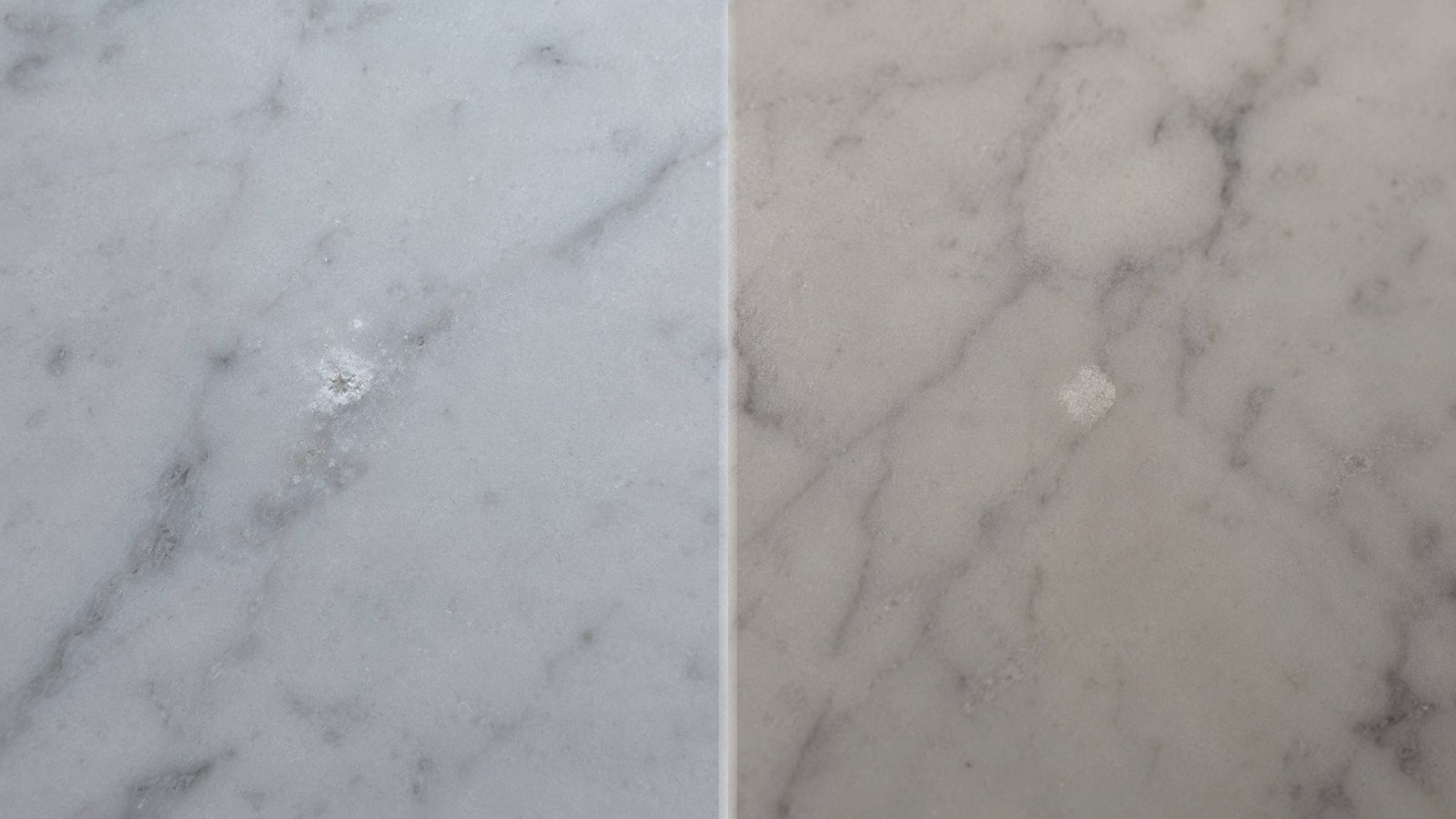
A light mark after an impact is not always an ordinary stain
When something hard or heavy falls on marble, a light or white mark can appear. In practice, this is often called impact bruising. It can look like a stain, limescale or dirt, but technically something else is happening: the crystal structure of the marble has been locally damaged.
Marble consists of crystals. When a hard point load strikes the stone, those crystals can break or become bruised. As a result, light passes through the stone differently and a white, milky or pale mark appears.
Important: with impact bruising, the problem is not only on the surface. That is why such a white mark can sometimes remain visible even after the marble has been sanded flat again.
How does impact bruising occur in marble?
Impact bruising usually occurs when a sudden force is concentrated on a small area. Examples include:
- a knife, pan, glass or other hard object falling onto a marble floor;
- a small stone under a shoe;
- point load near a kitchen, dishwasher or cutlery drawer;
- a furniture leg or appliance with a small hard contact point;
- a tool landing on the stone with a point or sharp edge.
It does not have to be a huge impact. A small hard point can cause considerable damage precisely because all the force is concentrated on a tiny part of the stone.
How do you recognise impact bruising?
Impact bruising in marble is often recognised by one or more of these features:
- a light, white or milky mark;
- a small central pit or dent;
- a mark that does not disappear with cleaning;
- damage that visually seems to sit "inside" the stone;
- a white, frosted-looking crystal structure;
- sometimes a small pit that can be felt, even if the rest of the surface feels flat.
With some damage, the point of impact is clearly visible. With other damage, you mainly see a white crystal fracture without a large chip.
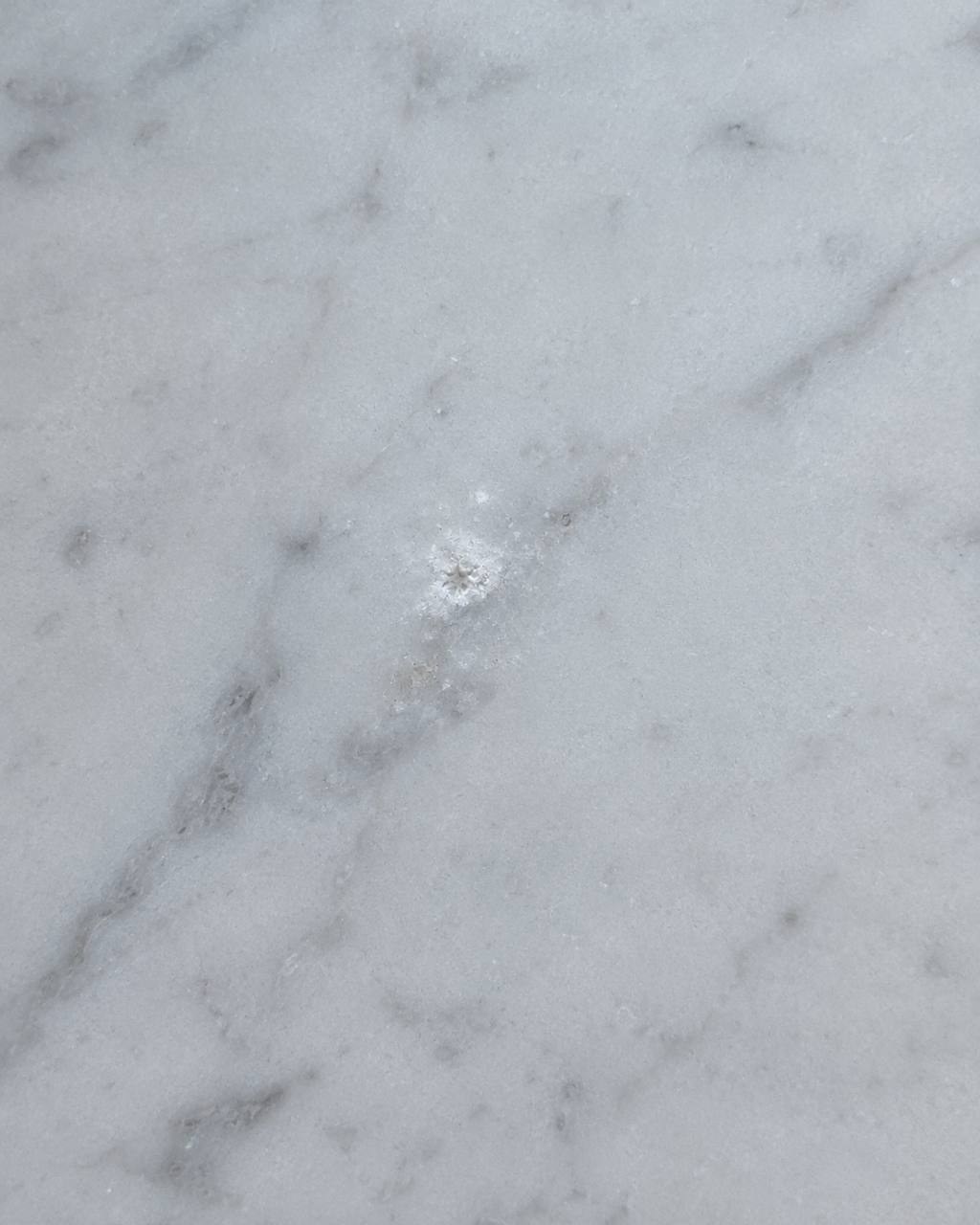
Example 1: impact bruising with a small pit
With this type of damage, a small impact point is often visible. Around that point, the marble becomes lighter or whiter. This happens because the crystals in the stone have been broken or bruised.
The surface damage can look relatively small, while the optical discolouration sits deeper in the material. Sometimes you can feel a small pit with your fingertip. Sometimes the pit is hardly noticeable, but the white mark remains clearly visible.
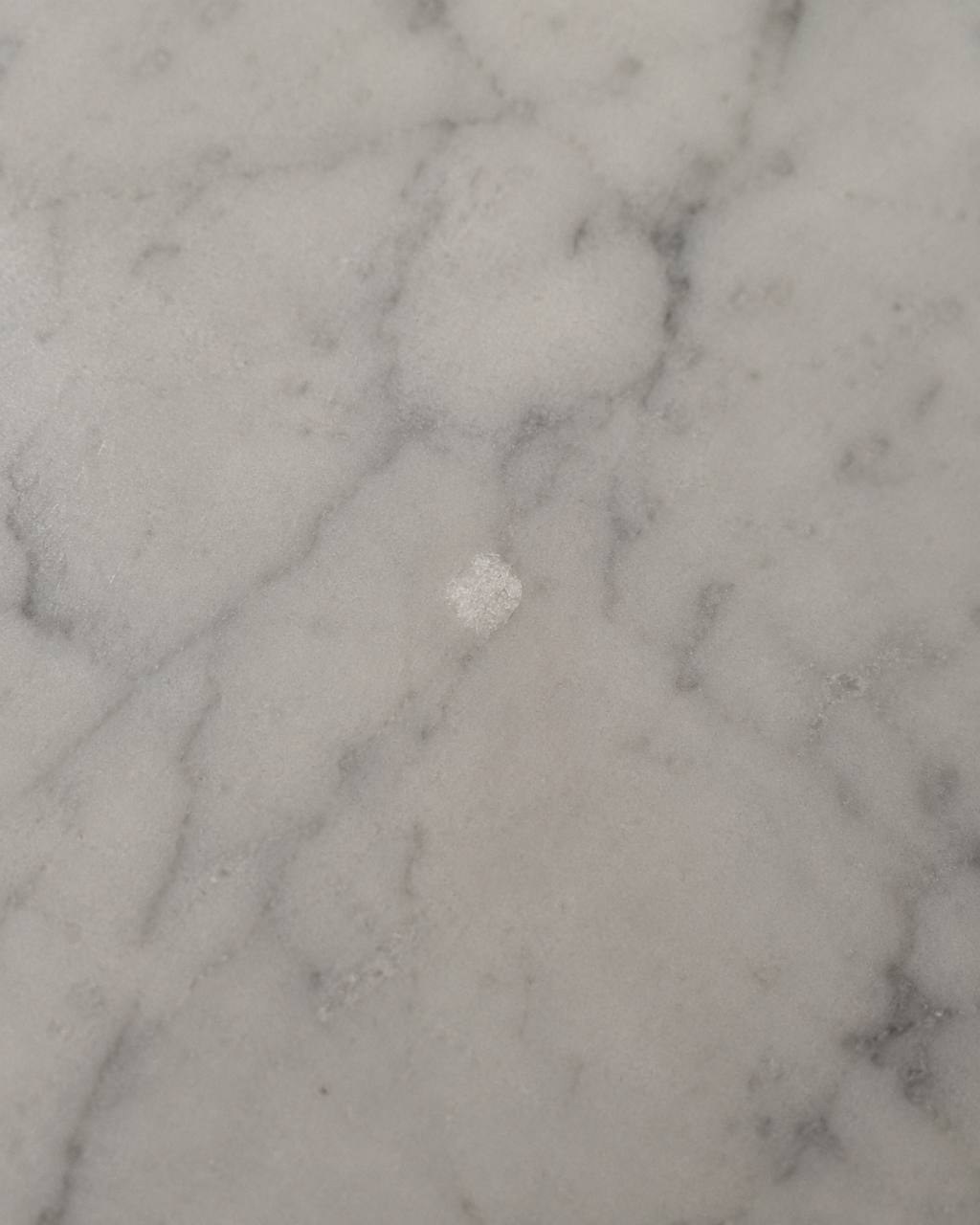
Example 2: white impact bruising without a large chip
With this form, you see less of an open defect and mainly a white mark in the stone. It is often confused with an ordinary stain, limescale, acid mark or dirt.
However, the problem usually lies deeper. The crystals reflect light differently because they have been locally damaged. That is why cleaning helps little or not at all.
Is impact bruising the same as a stain?
No. An ordinary stain is usually on the surface or just beneath it. Think of grease, moisture, dirt or discolouration from a liquid. Such stains can sometimes be cleaned or treated.
Impact bruising is different. The structure of the marble itself is damaged. The white effect is not caused by something lying on the stone, but by the material locally reflecting light differently.
That is why impact bruising does not disappear with normal cleaning.
Read also: removing stains from marble
Why can the white mark remain visible after sanding?
With marble damage, people often think: "If we sand the surface flat, it will be gone." For a superficial scratch, that can be true. With impact bruising, it is not always true.
If the crystal fracture extends deeper than just the top layer, the white mark can remain visible after the marble has been sanded flat again. The pit may technically disappear, but the light mark remains optically present.
That is because, with marble, you are not looking only at the surface. You also look partly into the crystal structure of the stone. If that structure is damaged beneath the surface, light continues to break differently there.
Can impact bruising be repaired?
That depends on the depth and severity of the damage.
A specialist first checks whether it is truly impact bruising, or for example a scratch, chip, acid mark or normal soiling. After that, several repair options are possible:
-
Local flattening
If there is a tangible pit or edge, the surface can sometimes be sanded flat again. -
Honing or polishing
After sanding, the finish is brought back towards the existing gloss level of the floor, table or slab. -
Assessing the result in normal light
If the crystal fracture sits deeper, the white impact bruise can remain visible. The surface is then improved, but the optical damage is not completely gone.
Honest advice is important here: impact bruising can often be improved, but not every impact mark can be made completely invisible.
More about the difference between sanding and polishing
Difference between scratch, chip, acid mark and impact bruising
Scratch
A scratch is usually line-shaped damage to the surface. It can often be reduced by sanding, honing or polishing.
Chip
A chip is a piece of material that has actually been knocked out of the stone. Depending on location, colour and finish, it can sometimes be filled or touched in.
Acid mark
An acid mark occurs when acid, for example lemon, vinegar or the wrong cleaning products, attacks calcareous stone. This often creates a dull patch.
Impact bruising
Impact bruising is caused by impact or point load. The stone is then internally bruised or fractured. The result is often a light or white mark, sometimes with a small pit.
Why do you often see impact bruising in kitchens?
Kitchens involve many point loads. Think of cutlery falling from a drawer, a knife tip hitting the floor, a pan slipping from your hand or a small stone under a shoe.
This often happens around a dishwasher, kitchen island, cutlery drawer or walking route. Marble can withstand a lot, but a hard point load on one small area remains a risk.
How can you reduce the risk?
You cannot always prevent impact bruising, but you can reduce the risk:
- use good entrance mats;
- prevent sand and small stones under shoes;
- lift heavy objects instead of sliding them;
- use felt pads or soft glides under furniture;
- be careful with knives, pans and heavy kitchen utensils above marble;
- check hard contact points under appliances or furniture.
The main issue is small hard points. They can cause more damage than a larger object whose weight is spread over a wider area.
Conclusion
Impact bruising in marble is not an ordinary stain. It is damage to the crystal structure caused by impact or point load. This creates a light or white mark, sometimes with a small pit.
Sometimes the mark can be clearly improved by sanding, honing and polishing. But if the crystal fracture extends deeper into the marble, the white impact bruise can remain visible even when the surface is completely flat again.
Unsure whether a light mark in marble is a stain, acid mark, chip or impact bruise? Have it assessed first before you start sanding or experimenting with cleaning products yourself.
About the author
Jeroen Rutgers
Jeroen Rutgers specialises in restoring, cleaning, sanding, polishing and protecting natural stone. Through DecoStone Natuursteen he works on marble, travertine, terrazzo, Belgian bluestone, granite and other natural stones in homes, shops, listed buildings and hotels.
Want to be sure which treatment is safe?
Send photos of the surface, room and problem. DecoStone assesses the material, damage pattern and risks before advising on a treatment or quotation.
Related articles
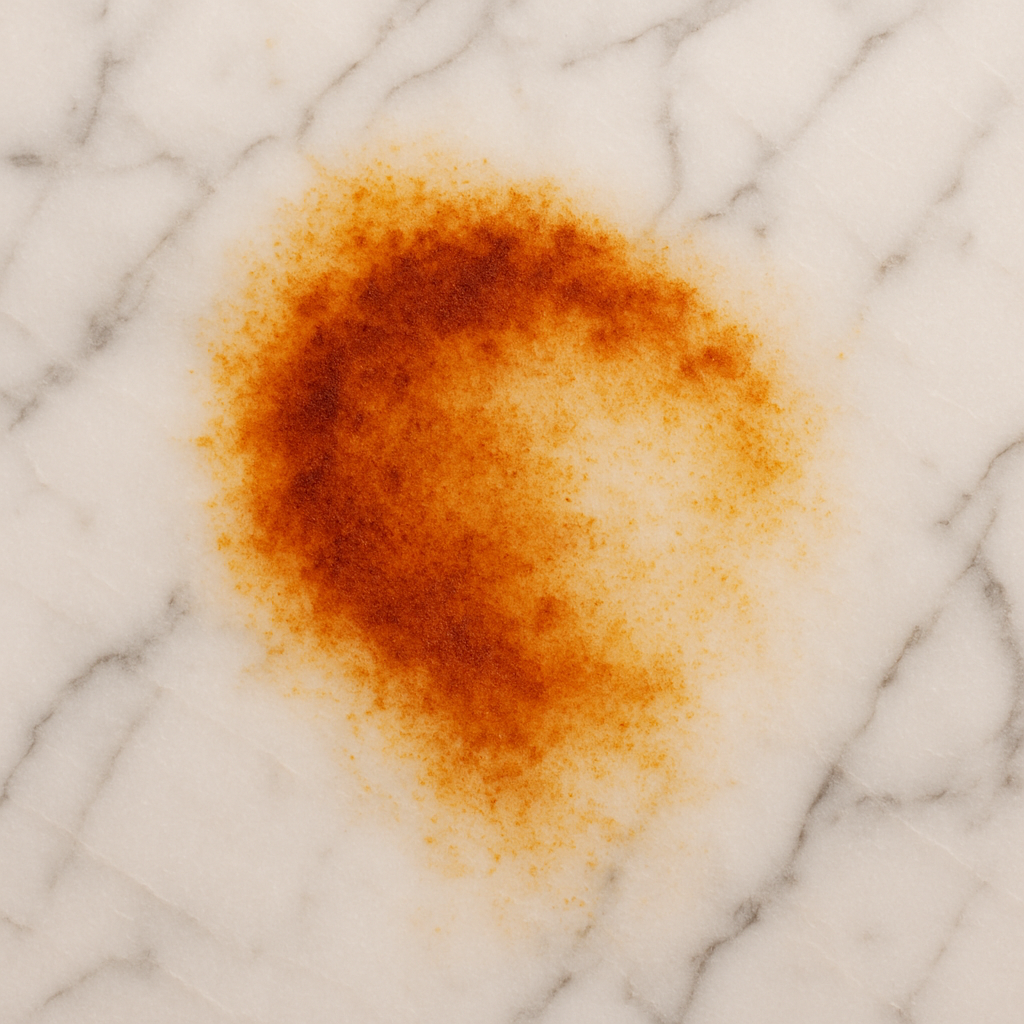
Removing Rust Discolouration from Natural Stone: An Honest Look at What Is Possible
Rust discolouration is one of the most stubborn problems in natural stone. Sometimes 90% of the stain disappears; sometimes 25% improvement is the maximum. Here is what to expect.
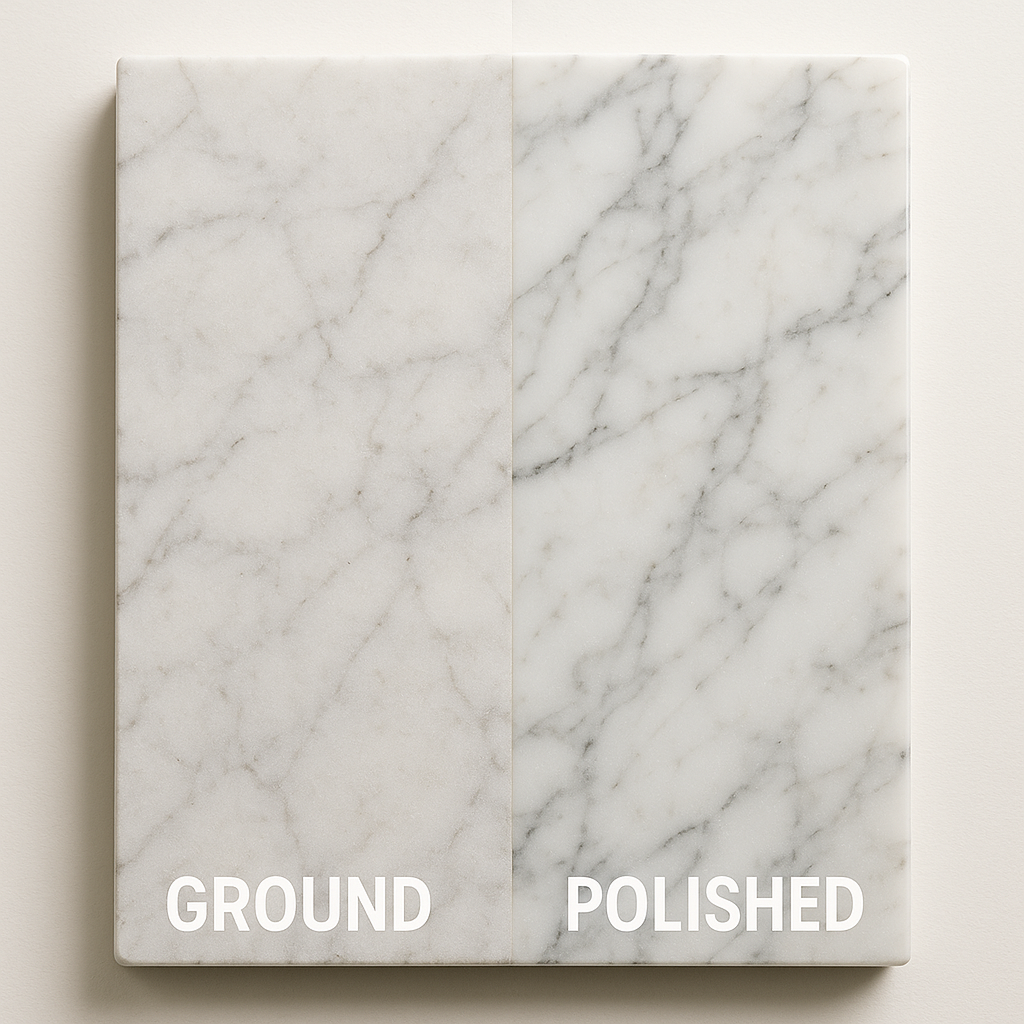
The Difference Between Grinding and Polishing Natural Stone
Grinding and polishing are often used interchangeably, but they are two very different processes with different goals and different results.
Marks and Polishing Bands in Taj Mahal Quartzite: What Repair Is Realistic?
Taj Mahal quartzite is hard, light-coloured and valuable. Marks or polishing bands after installation are difficult to correct. Read what makes repair realistic and when inspection should come first.