Removing Rust Discolouration from Natural Stone: An Honest Look at What Is Possible
Rust discolouration is one of the most stubborn problems in natural stone. Sometimes 90% of the stain disappears; sometimes 25% improvement is the maximum. Here is what to expect.
DecoStone Natural Stone
Natural stone specialist · Amsterdam
Table of contents
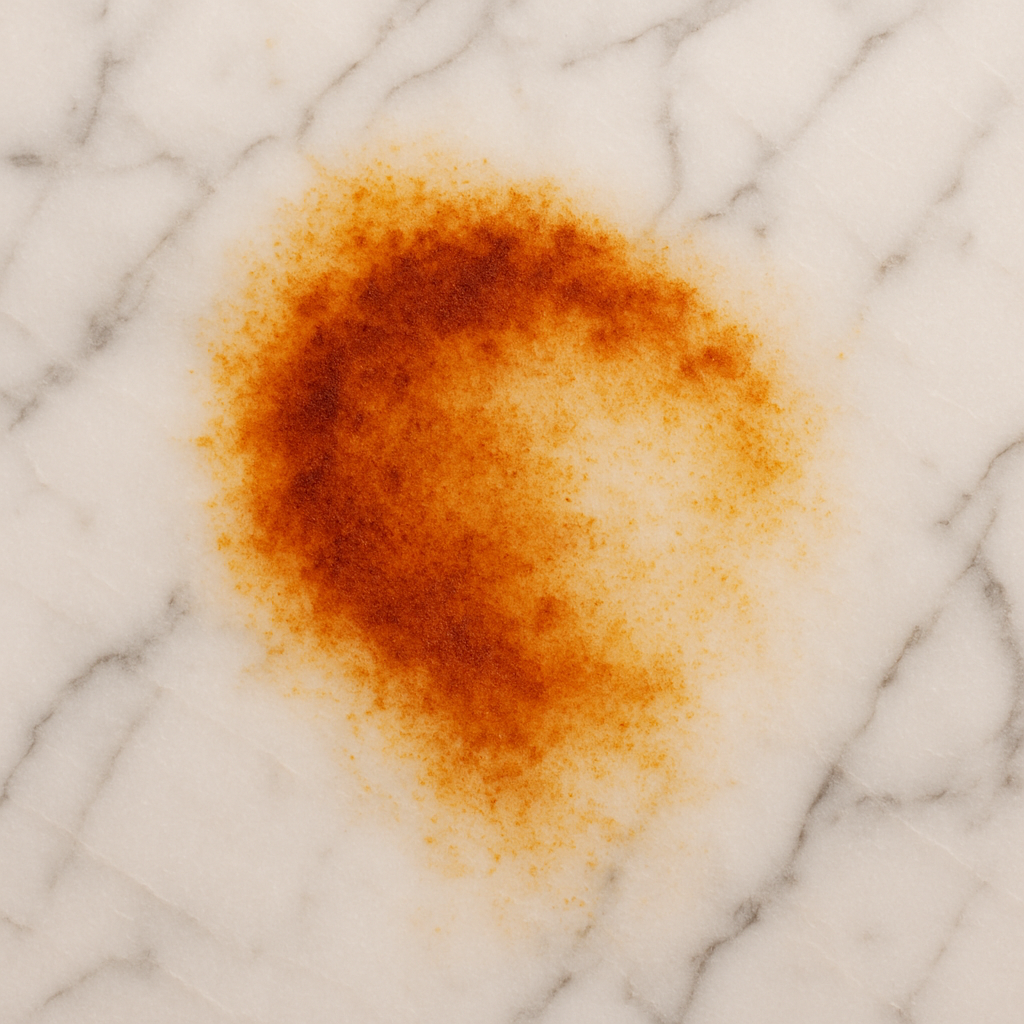
Rust in stone: more complex than it seems
An orange-brown mark on your white marble worktop or on your granite terrace tiles is immediately recognisable: rust discolouration. But the treatment is anything but simple, and results can vary greatly.
Rust discolouration in natural stone is not the same as rust on metal that you can simply sand away. Iron molecules have settled into the pores of the stone — sometimes deep, sometimes widely spread. Removing them requires chemical products that convert the iron compounds, and those products react differently with every stone type, every form of rust and every depth of penetration.
Where does rust in stone come from?
There are two sources:
External rust sources:
- Metal furniture legs, plant pots or gutters that drip rusty water
- Iron-rich sprinkler water or mains water with a high iron content
- Metal tools that have been left on the stone
Internal rust sources:
- Iron-bearing minerals in the stone itself — this occurs in granite, gneiss and certain sandstones
- Internal iron veining that starts to oxidise due to moisture movement
The distinction is crucial. External rust is superficial and sits in the upper pores. Internal rust can be centimetres deep in the stone and is considerably more difficult — sometimes impossible — to remove completely.
How does professional rust removal work?
Professional rust removers for stone are based on oxalic acid, phosphoric acid or EDTA chelating agents. These compounds chemically bind and dissolve iron ions so they can be rinsed out.
The method:
- Thoroughly clean the stone to remove surface dirt
- Apply the rust remover and allow it to work — contact time varies from 15 minutes to several hours
- If necessary, cover with plastic film to prevent drying out (the poultice method)
- Rinse with clean water and neutralise
- Assess the result — repeat if necessary
The poultice method (applying a paste to the stain, covering it and allowing it to dry slowly) is more effective than a liquid for deep rust: the slow drying draws the chemical compounds and dissolved iron toward the surface.
Honest expectations: what is achievable?
This is the part we always explain honestly, even when it is not what people hope to hear.
Good results (80–95% improvement) are realistic with:
- Fresh, superficial rust caused by a plant pot or metal object that stood there briefly
- External rust sources that were dealt with quickly
- Dense, well-impregnated stone where the rust has not penetrated deeply
Moderate results (25–60% improvement) are the reality with:
- Rust that has had years to penetrate
- Internal rust sources from the stone itself
- Porous, untreated stones where iron molecules have spread deeply and widely
- White Carrara marble with grey veining that contains iron — the rust can sometimes keep returning
Sometimes full removal is not possible:
- If the rust sits deeper than the treatment can reach
- If it is an internal mineral issue — then the stain may fade after each treatment but not disappear
- If the stone has already been damaged by previous incorrect attempts (hydrochloric acid, bleach)
What you can do yourself — and what you should not
Trying it yourself can make sense when:
- The stain is small and fresh
- The stone is granite or bluestone (less sensitive to chemical products)
- You are willing to test the product on an inconspicuous area first
Use a rust remover specifically made for stone — never all-purpose cleaner, toilet cleaner or bleach. These damage the stone and make the problem worse.
Calling in a professional is wise when:
- The stains are large or there are several affected areas
- The stone is white or light-coloured marble (sensitive to etching)
- The rust has been present for a long time
- You are unsure where the rust comes from
After treatment: repair and protection
After the rust has been removed as far as realistically possible:
- Re-polish or hone the treated area — chemical products can leave a slightly dull effect
- Impregnate the stone immediately after treatment — open pores are now extra sensitive to new staining
- Remove the external source — if rusty water continues to drip onto the stone, the process starts again
More about floor renovation after serious damage: step by step
With internal rust, impregnate as well as possible to slow further oxidation. Completely stopping it is almost impossible when the stone contains internal iron-bearing veining.
Summary
| Situation | Expected result |
|---|---|
| Fresh external rust, well-impregnated stone | 85–95% improvement |
| Older external rust, non-impregnated stone | 50–75% improvement |
| Internal rust from the stone itself | 25–60% improvement, may return |
| Rust after incorrect use of hydrochloric acid/bleach | Uncertain — ask a professional |
Rust removal is specialist work with variable outcomes. An honest assessment on site is always worth more than a guarantee on paper.
Also read about white deposits on natural stone — another common problem
Need help?
Are you unsure about the right approach, or would you like to know what is possible? Send a photo via WhatsApp and we will give you honest advice — without obligation.
Want to be sure which treatment is safe?
Send photos of the surface, room and problem. DecoStone assesses the material, damage pattern and risks before advising on a treatment or quotation.
Related articles
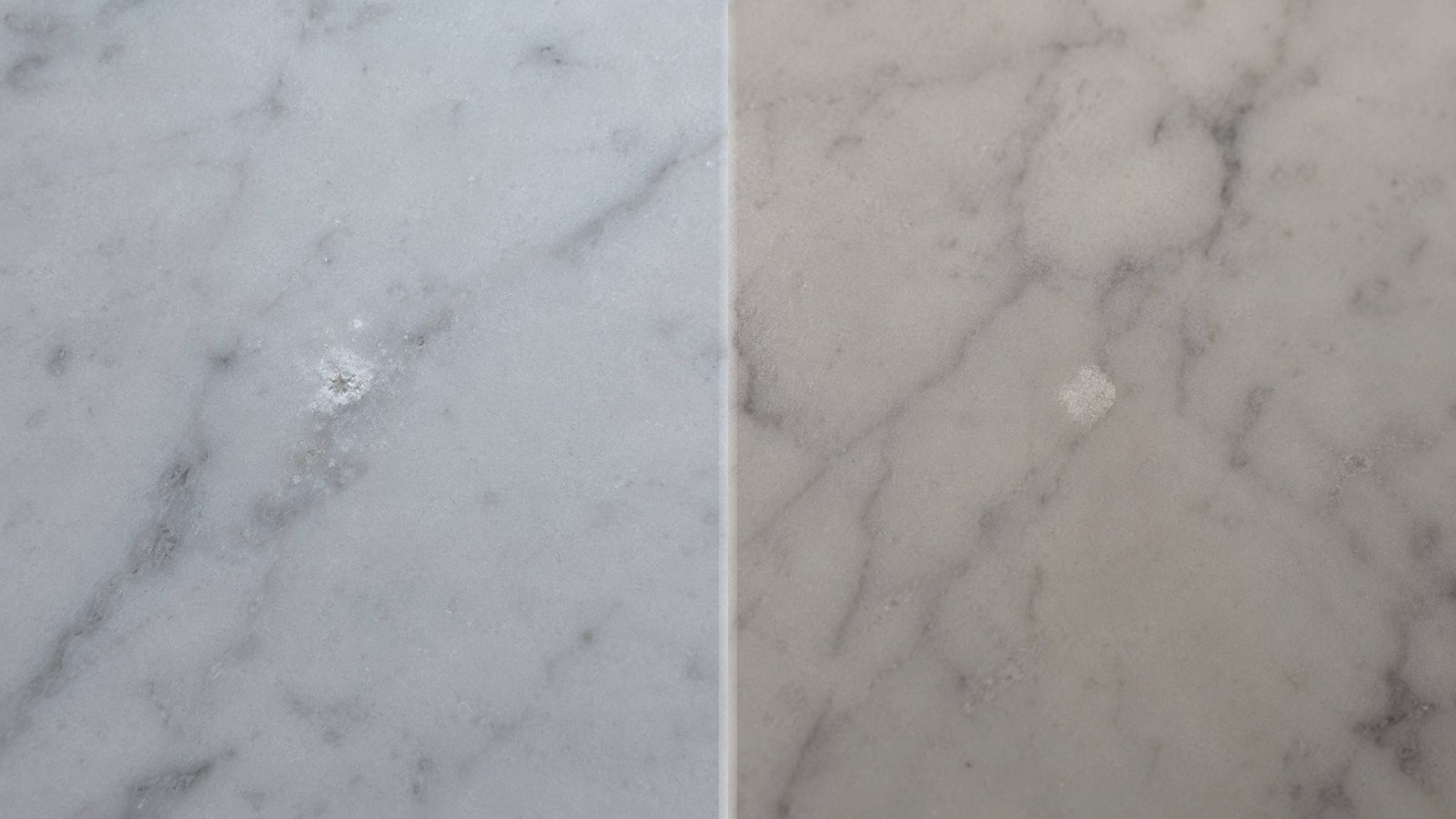
Impact Bruising in Marble: White Marks from Impact or Point Load
A light or white mark in marble after an impact is often not an ordinary stain, but impact bruising: broken crystals caused by impact or point load.
Marks and Polishing Bands in Taj Mahal Quartzite: What Repair Is Realistic?
Taj Mahal quartzite is hard, light-coloured and valuable. Marks or polishing bands after installation are difficult to correct. Read what makes repair realistic and when inspection should come first.
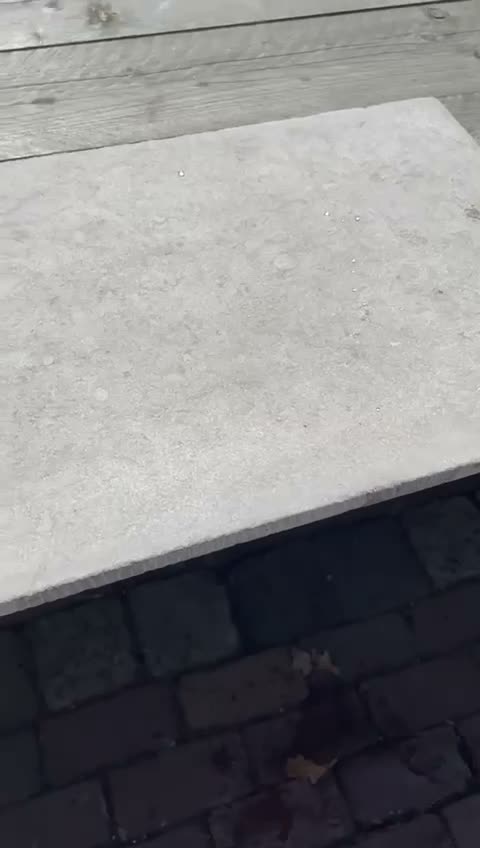
Restoring Dull Spots in Natural Stone: Does the Whole Floor Have to Be Cleared?
Does your natural stone floor have local dull spots? Learn when local repair is possible, when a larger area looks better and which photos are needed for advice.