Belgian Bluestone: Everything You Need to Know
Belgian bluestone is one of the most widely used and valued natural stones in the Netherlands and Belgium. This complete guide explains what it is and how to use it.
DecoStone Natural Stone
Natural stone specialist · Amsterdam
Table of contents
What is Belgian bluestone?
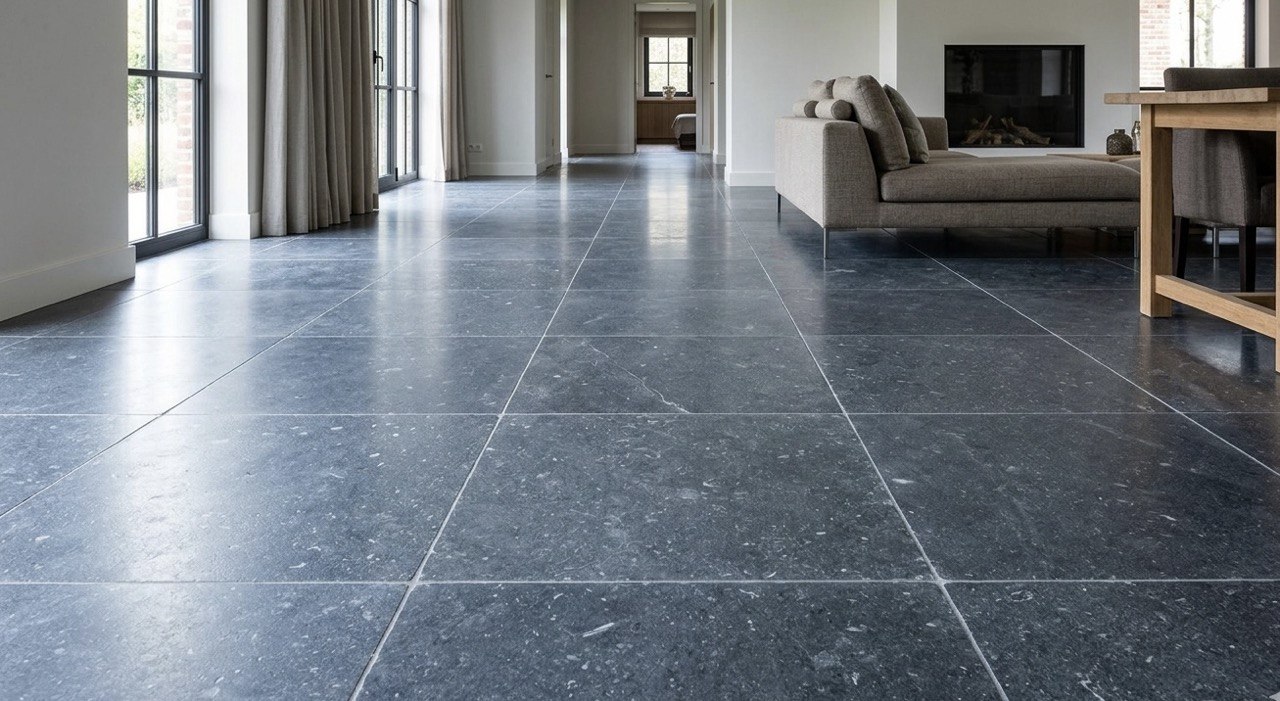
Belgian bluestone is a dark grey to blue-grey limestone that has been quarried for centuries in southern Belgium, mainly in the region around Soignies, Aiseau-Presles and the Hainaut basin. Its international name is petit granit — a historic name referring to its fine grain structure, which can look somewhat granite-like, although geologically it is limestone.
The stone is approximately 360 million years old and formed during the Devonian and Carboniferous periods, when the area was a shallow tropical sea. The remains of small marine animals — crinoids, corals and shellfish — were compressed in the stone and darkened into the characteristic dark mass. With a magnifying glass, these fossil fragments can sometimes still be seen as small light specks in the dark matrix.
That makes Belgian bluestone literally a fossil-rich stone: every slab is an imprint of a prehistoric ecosystem.
How do you recognise Belgian bluestone?
Belgian bluestone has several recognisable features:
- Colour: dark blue-grey, relatively uniform in tone
- Structure: fine-grained, compact matrix with visible fossil remains on closer inspection
- Surface: depending on the finish: flamed (rough), chiselled/striated, sawn or polished
- Weight: heavy; a one-centimetre-thick slab quickly weighs 25–28 kg per m²
Visually, Belgian bluestone differs from Chinese bluestone by its slightly warmer, more consistent blue tone. But honestly: for a non-specialist, they are hard to tell apart in a showroom. A certificate of origin or test report provides certainty.
Applications
Belgian bluestone is one of the most versatile outdoor stones available, and it is also used extensively indoors.
Outdoors: Terraces, driveways, façade plinths, copings, stairs, pavements, thresholds, wall caps and window sills. Belgian bluestone has proven for centuries that it can handle Dutch and Belgian winters. In historic city centres you see it everywhere: the grey paving stones around the Amsterdam canals are largely Belgian bluestone or imitations of it.
Indoors: Floors in halls and kitchens, stair treads, worktops, window sills and wall panels. The stone works very well in classic or industrial interiors. Polished, it has an elegant look; chiselled or flamed, it suits a tougher, rougher concept.
Kitchen worktop: Belgian bluestone is used for kitchen worktops, but note: it is a limestone. Acids such as lemon juice or vinegar attack the surface. In a heavily used kitchen, it requires conscious use and regular impregnation.
Advantages
- Proven durability: the stone has been used in architecture for centuries
- Excellent frost resistance (water absorption usually < 0.5%)
- High compressive strength (200–250 MPa)
- Attractive, timeless appearance
- Available in certified quality with proof of origin
- Can be repaired well if damaged (sanding, repolishing)
Disadvantages
- Sensitive to acids: etch damage from lemon juice, vinegar or acidic cleaners
- It greys outdoors: the blue tone fades to grey, which is normal but not expected by everyone
- Heavier than some alternative materials
- More expensive than Chinese variants (see also our article on the difference)
- Not suitable as a kitchen worktop if used carelessly without good impregnation
Maintenance
Impregnation
Impregnate Belgian bluestone after installation and repeat this annually for outdoor applications, and every 2–3 years indoors. Use a water-based stone impregnator suitable for limestone. A good impregnator penetrates the pores and forms a barrier against water and dirt ingress.
Never use oil on bluestone: it causes stains and encourages algae growth outdoors.
Cleaning
For daily cleaning, warm water with a neutral stone soap is sufficient. Avoid vinegar, citric acid and aggressive cleaning agents — they etch the calcite surface, even if you do not see it immediately.
For green deposits outdoors: use a biological algae remover without acid. Let it work, then rinse with water. Pressure washers are not recommended: they damage the surface and drive dirt deeper into the pores.
Repairing etch damage
Etch damage (white, matt marks caused by acid) can be repaired by light sanding and re-impregnation. With serious damage, a stone restorer can hone or repolish the stone.
Price indication
Belgian bluestone is not a cheap stone, and rightly so.
- Outdoor tiles (flamed/chiselled): €60–120 per m², depending on format and thickness
- Polished floor tiles: €80–150 per m²
- Window sills and thresholds: €80–200 per linear metre, depending on profile
- Kitchen worktops: custom made, usually €400–800 per linear metre including processing
Prices are guidelines and vary by supplier, format and finish.
Belgian bluestone vs. Chinese bluestone
There is a lot of bluestone on the market that is offered as “Belgian” but is actually of Chinese origin. Always ask for a certificate of origin or test report (water absorption EN 1925, frost resistance EN 12371) if you want to be certain what you are buying.
Read also our detailed article: Belgian bluestone vs. Chinese bluestone: what is the difference?
Do you have questions about using Belgian bluestone in your project? DecoStone will be happy to help you choose the right material and finish.
Need help?
Are you unsure about the right approach, or would you like to know what is possible? Send a photo via WhatsApp and we will give you honest, no-obligation advice.
Want to be sure which treatment is safe?
Send photos of the surface, room and problem. DecoStone assesses the material, damage pattern and risks before advising on a treatment or quotation.
Related articles
Belgian Bluestone vs. Chinese Bluestone: What Is the Difference?
They can look the same, but their properties differ significantly. Belgian bluestone and Chinese bluestone are often confused. Read what to look for.
Cristallo Quartzite: Stone Profile, Maintenance and Points of Attention
Cristallo is a luxury quartzite with a crystalline, often translucent appearance. Read how to maintain, protect and assess this material safely.
Arduin: What Exactly Is It and Where Is It Used?
Arduin is a dark grey to black natural stone that is often confused with Belgian bluestone. This article explains what arduin is and where it is used.