Mohs Hardness of Natural Stone: What Does It Mean in Practice?
The Mohs scale tells you how scratch-resistant a stone is. But what do those numbers really mean? And why is Mohs hardness not the same as durability?
DecoStone Natural Stone
Natural stone specialist · Amsterdam
Table of contents
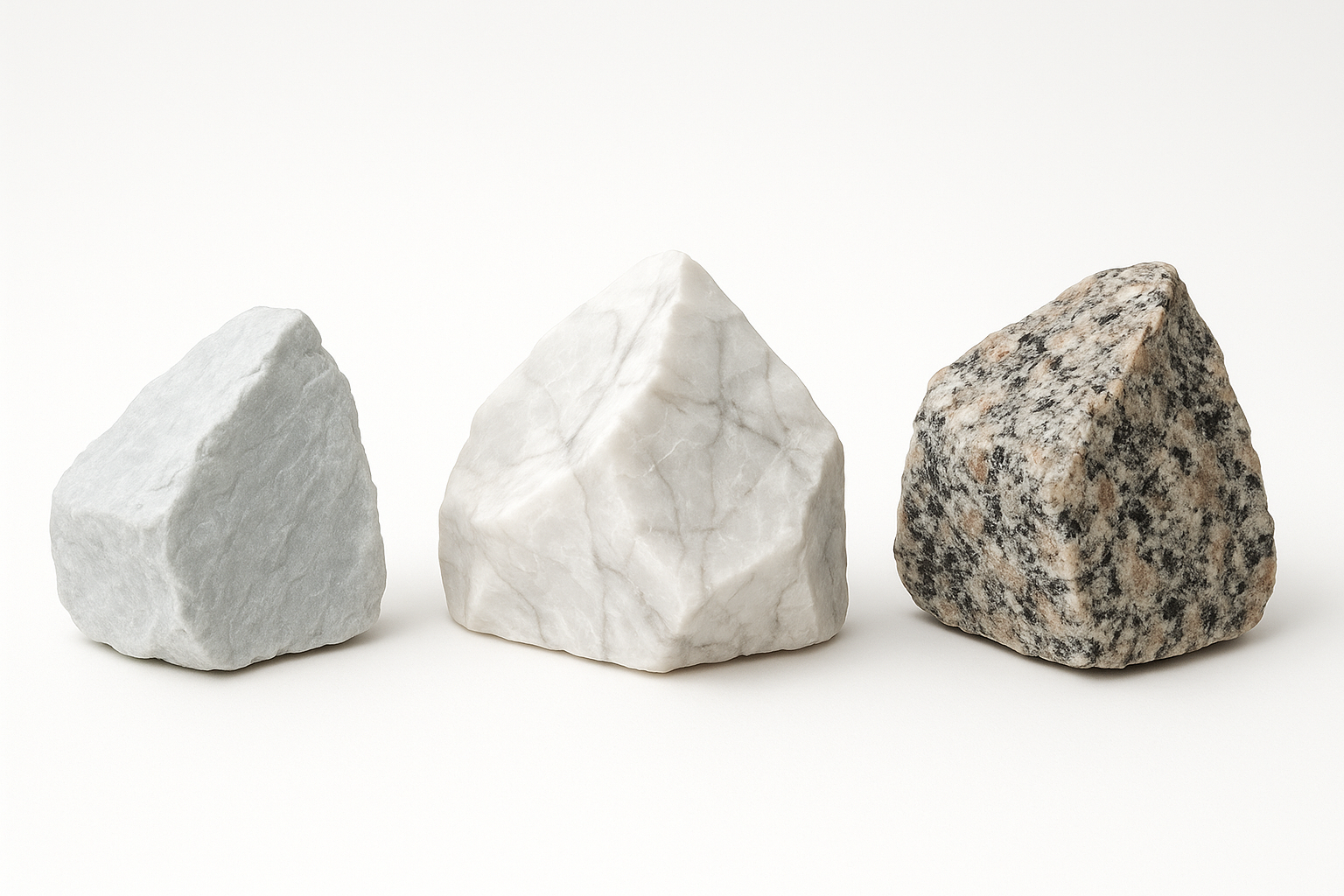
A scale from 1 to 10
Friedrich Mohs, a 19th-century mineralogist, devised a simple way to rank minerals by hardness in 1812: the scratch-test system. If mineral A leaves a scratch on mineral B, A is harder than B.
The scale runs from 1 (talc — the softest material) to 10 (diamond — the hardest). Each step is relative; the real hardness difference between steps is not linear. Diamond (10) is not twice as hard as corundum (9) — it is orders of magnitude harder.
For natural-stone practice, values from 2 to 7 are the most relevant.
Familiar reference points
| Mohs value | Mineral/material |
|---|---|
| 1 | Talc |
| 2 | Gypsum — a fingernail scratches this |
| 2.5 | Human fingernail |
| 3 | Calcite — a copper coin scratches this |
| 3.5 | Copper coin |
| 4 | Fluorite |
| 5 | Apatite |
| 5.5 | Knife or file |
| 6 | Feldspar |
| 6.5 | Steel file |
| 7 | Quartz — ordinary sand |
| 10 | Diamond |
How does natural stone score?
| Stone type | Mohs hardness | What it means |
|---|---|---|
| Marble | 3–4 | A knife or coin scratches the surface |
| Limestone | 2.5–3 | A fingernail or coin can already leave a scratch |
| Belgian bluestone | 3–4 | Comparable to marble |
| Travertine | 3–4 | Soft, sensitive to scratches |
| Slate | 3–4 | Layered structure is vulnerable |
| Sandstone | 4–6 | Varies strongly by type |
| Granite | 6–7 | Steel hardly scratches it |
| Engineered quartz (composite) | 7+ | Very scratch-resistant |
The practical meaning
Marble (3–4): A knife easily scratches the surface. Sand, grit and even dust particles under your shoe sole are harder than marble. This explains why a marble floor in a busy entrance hall shows scratch damage relatively quickly.
Granite (6–7): Steel has a hardness of 5 to 5.5. That means an ordinary knife does not scratch granite. Even quartz sand (hardness 7) can barely damage granite. This is what makes granite so suitable for heavy use.
Belgian bluestone (3–4): Despite the word “hard” in some names, its hardness is comparable to marble. The name refers more to density and durability outdoors than to scratch resistance in the Mohs sense.
Mohs is not the same as durability
This is where nuance matters — and not everyone understands it.
Hardness ≠ wear resistance
A soft stone can be wear-resistant if the crystal structure is strongly bonded. Belgian bluestone is relatively soft (Mohs 3–4) but lasts for decades outdoors because of its dense structure and low porosity.
Hardness ≠ frost resistance
Frost resistance depends on porosity, not hardness. A hard granite with high porosity (it exists) is more vulnerable to frost than a soft bluestone with low porosity.
Hardness ≠ chemical resistance
Marble is harder than calcite but just as sensitive to acids — because it is mainly calcite. Hardness says nothing about how the stone reacts to acids, alkalis or salt.
What to take to the showroom
If you are considering a stone, ask not only about Mohs hardness but also about:
- Porosity — how readily does it absorb water?
- Water absorption coefficient — the technical measure for moisture absorption
- Acid resistance — relevant for kitchens, bathrooms and terraces
- Flexural tensile strength — bending strength, relevant for thin worktops and large formats
Mohs hardness is a useful guideline for scratch resistance. It is no more than a guideline.
Practical advice based on hardness
- Kitchen worktop, heavy use: choose stone with Mohs ≥ 6 (granite, engineered quartz)
- Living-room floor, normal use: Mohs 3–4 is fine if you impregnate the stone and keep sand outside
- Busy entrance hall or hospitality space: Mohs ≥ 5, preferably higher
- Outdoor terrace: hardness is less relevant than porosity — granite or dense bluestone
- Bathroom wall (little mechanical contact): even Mohs 3 is perfectly acceptable
If you understand the Mohs scale, you make more conscious choices. And conscious choices lead to fewer disappointments.
Need help?
Are you unsure about the right approach, or would you like to know what is possible? Send a photo via WhatsApp and we will give you honest, no-obligation advice.
Want to be sure which treatment is safe?
Send photos of the surface, room and problem. DecoStone assesses the material, damage pattern and risks before advising on a treatment or quotation.
Related articles
How Is Marble Formed? The Geology Behind the Material
Marble is not a random stone. It is the result of millions of years of pressure, heat and chemical change. Understanding how marble forms helps you understand how it behaves.
Colour Differences in Natural Stone: Normal Variation or a Defect?
Your new floor has colour differences between the tiles. Some are darker, others have more veining. When is that normal — and when is it a problem?
Coloured Natural Stone: Why Deep Colour Is Not Always Natural
Some natural stones are treated with dyes, oil or colour enhancers. That can look attractive, but sanding, polishing or degreasing can reveal colour differences more quickly.