Coloured Natural Stone: Why Deep Colour Is Not Always Natural
Some natural stones are treated with dyes, oil or colour enhancers. That can look attractive, but sanding, polishing or degreasing can reveal colour differences more quickly.
DecoStone Natural Stone
Natural stone specialist · Amsterdam
Table of contents
Deep colour is not always the natural colour of the stone
Natural stone is often chosen for its colour, pattern and depth. A green worktop, a red marble, a blue onyx or a deep black natural stone can be beautiful. Yet that colour does not always come entirely from the material itself.
Some slabs are treated by suppliers or producers with dyes, oil, resin or colour-enhancing products. This can make the stone look deeper, fuller or more even in colour. In the showroom, that can be attractive. During later maintenance, repair or polishing, it can cause problems.
For natural-stone specialists, coloured stone is difficult because normal work can create colour differences. Even light sanding, polishing or degreasing can be enough to locally change or remove an applied colour layer.
That is why, when buying stone, it is often wiser to choose a good-quality, homogeneously coloured stone than a dull material that has later been artificially made darker or deeper.
Read also: what to look for when buying natural stone
Why is natural stone coloured?
Natural stone is a natural product. No two slabs are exactly the same. Colour, veining, density and structure can differ by quarry, block, layer and sawing direction. That is part of the material.
Commercially, that is not always convenient. A slab that is naturally a little flat in colour, less even in appearance or has lighter zones is harder to sell than a slab with a deep, full colour. That is why some stones are treated to make them more visually appealing.
This is done, among other reasons, to:
- make the colour look deeper
- make dull areas appear fuller
- reduce colour differences within a batch
- make a stone look more exclusive or expensive
- give onyx and other semi-transparent stones more effect
- make weaker batches saleable after all
This is especially common with striking colours. Think of green, red, blue and sometimes black. In more porous stones, dye or colour enhancer can also penetrate the surface more easily.
Two common ways natural stone is coloured
There are several ways natural stone can be treated for colour. In practice, we mainly see two forms that can cause problems later.
1. The back of onyx or semi-transparent stone is coloured
With onyx and some other translucent natural stones, the back is sometimes coloured before the material is bonded or processed. This may be done with pink, blue or other tones to influence the colour perception from the front.
Onyx is often partly translucent. What happens at the back can therefore be visible at the front. By colouring the back, a slab can appear warmer, more intense or more dramatic.
Examples:
- a light onyx gains a pink glow through a coloured backing
- a blue tone is strengthened with pigment or coloured adhesive
- a flat slab gains more depth because the back contributes optically
- lighter zones are corrected with a coloured backing layer or bonding layer
This can be beautiful, but it also means that the final colour does not come only from the stone itself. The colour partly depends on the adhesive layer, backing reinforcement, substrate or pigment layer behind the slab.
Why does this create a risk during repair?
When repairing onyx, it is sometimes difficult to determine exactly where the colour comes from. Is it in the stone itself? In the back? In the adhesive? In a resin layer? Or in a combination of all of these?
If a worktop later cracks, is damaged or is locally bonded, the new repair can react differently to light. A small change in adhesive, thickness, substrate or degree of polishing can already be visible from the front.
With onyx, therefore, the surface is not the only factor. What sits behind the stone also determines how the colour is ultimately perceived.
More about onyx worktops and maintenance
2. The visible surface is treated with dye or colour enhancer
The second form occurs with various green, red, blue and sometimes black natural stones. Here, the visible surface is treated with dye, oil, resin, colour enhancer or a similar product.
The slab looks better on delivery. The colour appears richer, deeper and more even. But if the treatment is not stable or does not penetrate deeply enough into the material, that can become visible later.
Examples:
- a green natural stone is darkened to create more depth
- a red stone is made fuller because the natural colour is somewhat weak
- a blue stone gets extra intensity through pigment or colour enhancement
- a black natural stone is treated to look deeper black
- lighter areas in a slab are touched up so the whole appears more homogeneous
From the outside, this is not always immediately visible. Especially not when the slab has just been installed, is clean and has a fresh oil, wax or colour-enhancer finish.
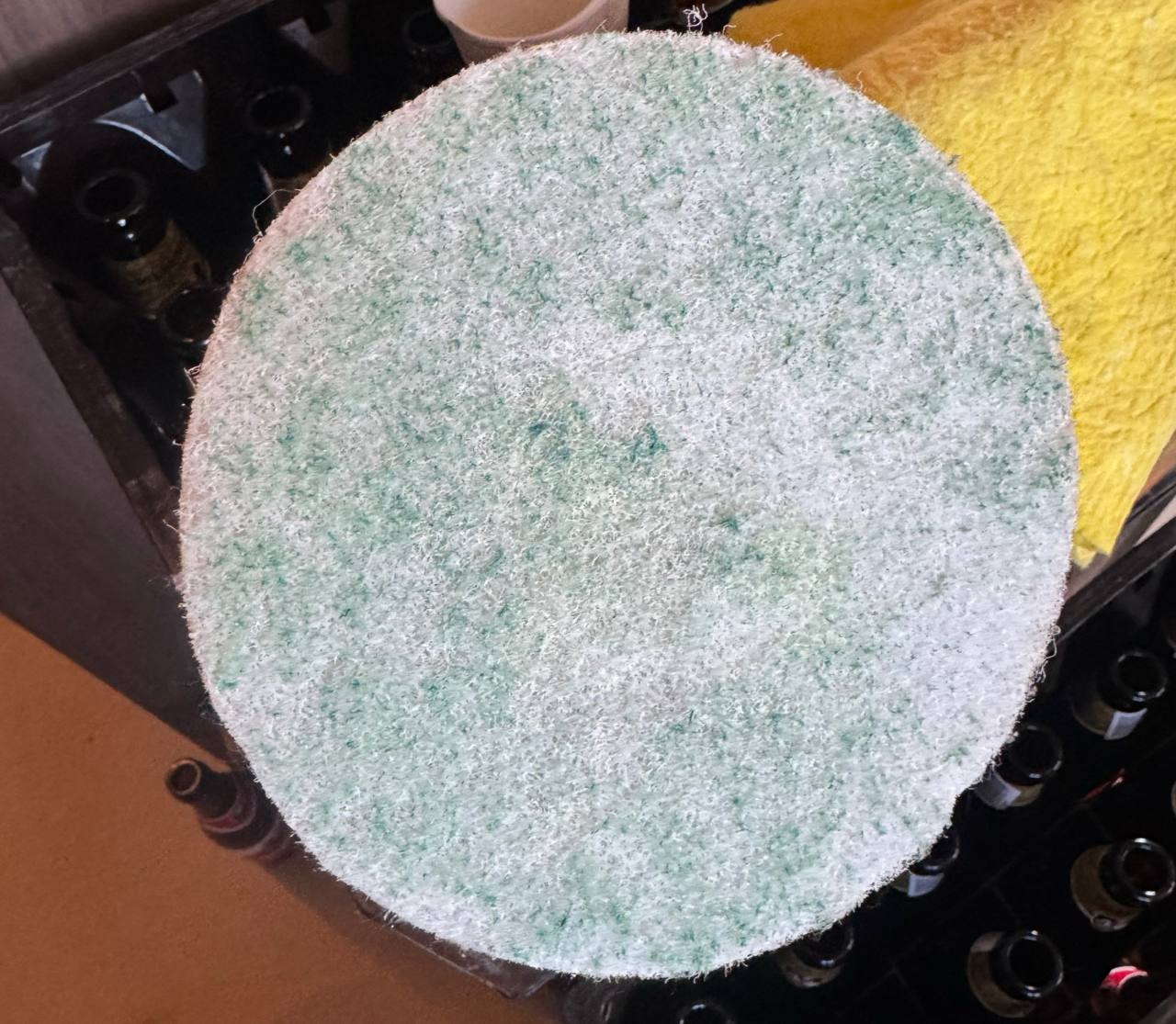
Practical example: green colour on the polishing pad
When polishing a naturally homogeneously coloured stone, what normally comes free is mainly grinding slurry, stone dust and dirt. That can be grey, whitish or dark, depending on the stone type.
With a dyed worktop, something else can happen: the polishing pad visibly takes up colour.
The photo with this article shows a white polishing pad that turned green after polishing a dyed worktop. That is a clear indication that green colour is coming loose from the surface. The colour is then not fully stable in the stone itself, but partly in a treatment on or just below the surface.
For the specialist, this is an immediate warning. If the pad carries away dye, the treated part of the worktop may also become lighter or more blotchy. The scratch or dull patch may technically disappear, while the treated zone then has a different colour from the rest of the worktop.
Repair work suddenly becomes much more complicated. You are not only restoring gloss or damage; you also have to make the colour visually match again.
What goes wrong during maintenance or repair?
The problem usually appears later. For example, when the worktop is cleaned, degreased, lightly sanded, polished or locally repaired.
A natural-stone specialist often works with normal techniques:
- cleaning
- degreasing
- light sanding
- polishing
- local stain treatment
- removing scratches
- restoring matt patches
- removing adhesive residues
- impregnating or protecting
With a naturally homogeneously coloured stone, this is usually manageable. The surface changes through the work, but the colour of the material itself remains reasonably predictable.
With coloured natural stone, this is different. Even light work can be enough to go through a colour treatment or make that treatment uneven.
Read also: polishing natural stone, when is it needed and what does it cost?
Colour difference from light sanding
In many repair jobs, only a little material needs to be removed. Think of removing a scratch, dull patch or light attack. Still, light sanding can be enough to open or partly remove an applied colour layer.
The treated spot may then:
- be lighter than the rest
- look flatter or duller in colour
- have less depth
- show a different undertone
- look drier or more matt than its surroundings
The damage itself may technically have been repaired, but visually a new problem has appeared. The area where work was done has a different colour from the rest of the slab.
Colour difference from polishing
Polishing changes the reflection of natural stone. A well-polished surface looks deeper and fuller than a matt surface. With untreated natural stone, this is normal and reasonably predictable.
With coloured natural stone, polishing can do two things at the same time:
- The gloss returns.
- The artificial colour layer is altered, moved or removed.
As a result, a polished spot can react differently from the rest of the slab. Sometimes it looks as if the spot has not been polished properly, while the real issue lies in the colour treatment.
For a customer, that is confusing. They see colour difference and think the work was not carried out correctly. In reality, the cause may lie in an earlier treatment of the material.
Colour difference from degreasing
Degreasing can also cause colour difference. That sounds strange, because degreasing is normally a preparatory step. But in some dyed or oil-treated stones, the colour enhancement sits partly in or on the surface.
Strong degreasers can:
- affect colour enhancers
- dissolve oily treatments
- remove old maintenance products
- loosen pigment residues
- make treated areas lighter
As a result, a worktop can look locally flatter or blotchy after degreasing. This is seen especially in stones where the colour is not stable throughout the material.
Why is this difficult for natural-stone specialists?
A natural-stone specialist wants control over the result. Repair work is often local. You treat a scratch, stain, dull patch or damage without immediately redoing the entire slab.
With coloured natural stone, that is not always possible neatly. The problem is then not only the damage, but the colour layer or colour treatment across the whole slab.
If one area becomes lighter through sanding, polishing or degreasing, you can sometimes only make that area visually match again by applying colour again. That is less ideal than working on stone that is homogeneously coloured by nature.
Disadvantages of local recolouring:
- the exact colour is difficult to reproduce
- the treatment can wear again later
- local touching up can remain visible
- the slab becomes dependent on maintenance products
- future repairs become more difficult
- the result is less durable than with homogeneously coloured stone
Recolouring is a correction, not an ideal starting point
If a coloured worktop develops colour difference, recolouring can sometimes help. For example with colour enhancer, oil, a pigment-containing treatment or a special product for natural stone.
But this is usually a correction afterwards. It is not the same starting point as a stone whose colour is naturally well established in the material.
Recolouring has limitations:
- the colour may turn out differently from the original factory treatment
- the product does not penetrate equally deeply everywhere
- porous areas absorb more than dense areas
- edges and repaired spots can react differently
- sunlight, cleaning and use can change the colour again
- future sanding or cleaning can bring back the same problem
Sometimes recolouring is the best practical solution. But it remains a compromise.
Why homogeneously coloured natural stone is better
A good-quality natural stone has colour, structure and pattern that are naturally present in the material. That does not mean every slab has to be perfectly even. Natural stone may have veins, clouds, shades and natural variation.
There is, however, an important difference between natural variation and artificial colour correction.
With homogeneously coloured natural stone:
- the colour is better established in the material itself
- repair work is more predictable
- scratches or dull patches can be touched up more reliably
- unnatural colour differences are less likely to occur
- the slab continues to look calmer in the long term
- maintenance is less dependent on colour-enhancing products
A slab that looks slightly less spectacular in the showroom, but has good colour in itself, can be a better long-term choice than a duller slab made artificially deep.
Cheap or striking can become more expensive later
An intensely coloured slab can be attractive, especially when the colour immediately stands out. But if that colour has partly been applied, it can later lead to costs and disappointment.
Examples:
- a scratch cannot be removed neatly without colour correction
- a dull patch may remain lighter after repair
- a stain treatment can create a lighter ring
- cleaning products can affect the colour enhancement
- a local repair can turn into treatment of the entire slab
In some cases, the full worktop has to be treated again so that one repaired spot does not stand out. That makes repair more expensive and less targeted.
How can you recognise coloured natural stone?
It is not always easy. Still, there are signals.
Look for:
- a slab with a strikingly deep colour that almost looks too even
- edges, saw cuts or the underside that are clearly lighter than the surface
- damage showing a much lighter core
- stone that releases colour during cleaning, sanding or polishing
- colour that changes after degreasing
- the back of onyx or semi-transparent stone having an unnatural tint
- dark oily zones visible in certain light
- colour that seems to sit mainly in the surface
- a sample piece that reacts strongly to sanding or degreasing
A good supplier can usually explain whether a slab has been treated. Ask in advance, especially with exclusive or strikingly coloured materials.
Questions to ask the supplier
When buying natural stone, it is wise to ask clear questions:
- Has the stone been factory treated?
- Has dye, resin, oil or colour enhancer been used?
- Is the colour present throughout or mainly on the surface?
- Has the back been coloured or treated?
- How does the stone react to sanding and polishing?
- Can the stone later be locally repaired without colour difference?
- Which maintenance products may or may not be used?
- Is an untreated sample available?
- Are edges and saw cuts the same colour as the surface?
Edges and saw cuts are especially important. If the surface is much darker than a fresh saw cut or damage, that may indicate a colour treatment.
Why a sample is valuable
When in doubt, a sample is sensible. It allows testing how the stone reacts to:
- water
- degreaser
- light sanding
- polishing
- impregnator
- colour enhancer
- acid-free cleaning
- normal maintenance products
A sample gives no complete guarantee, but it prevents many surprises. This is especially important with expensive worktops, custom work, onyx, exclusive marbles or strongly coloured natural stone.
What does this mean for maintenance?
With possibly coloured natural stone, careful maintenance is important.
Prefer not to use aggressive cleaning agents. Avoid strong degreasers, acids, abrasives and unknown stain removers. Products that deep-clean or dissolve grease can also influence colour enhancers or earlier treatments.
General advice:
- clean with a pH-neutral product for natural stone
- test new products first in an inconspicuous place
- do not use vinegar, anti-limescale cleaner or acidic bathroom cleaner
- avoid aggressive degreasers
- do not sand visible surfaces yourself
- have dull patches or scratches assessed before treatment
- when in doubt, ask whether the stone may be coloured or impregnated
Read also: what can you safely do yourself with natural stone?
What does this mean for repair?
When repairing possibly coloured natural stone, it must be clearly discussed beforehand that colour differences can arise or remain visible.
A restorer can often improve a great deal, but cannot always exactly reproduce the original factory colour treatment. This is especially important with local repairs.
A cautious approach usually consists of:
- Inspection of the material, colour and existing treatment.
- A small test in an inconspicuous place or on a sample.
- Careful cleaning or degreasing.
- Carrying out the local repair.
- Assessing whether colour correction is needed.
- If necessary, treating the whole slab again with a colour enhancer for a more even result.
For some slabs, local repair is sufficient. For others, the full surface must be included to limit colour difference.
Honest advice when buying
If you still have to choose, choose quality in the stone itself. Natural stone that has good colour by nature carries less risk during use, maintenance and repair.
A dull slab made attractive with colour enhancer or pigment can look appealing in the showroom. You often notice the real difference only later, when the worktop is used and maintenance becomes necessary.
So do not look only at the first impression. Ask about the treatment, inspect edges and saw cuts, request sample material and make sure you are well informed.
Conclusion
Coloured natural stone can look beautiful, but it has a technical downside. As soon as the material is cleaned, degreased, sanded, polished or repaired, the applied colour layer can visibly change. This creates colour differences that are not always easy to correct.
With onyx, colour from the back or adhesive layer can play a role. With green, red, blue and sometimes black natural stone, the surface may have been treated with dye, oil, resin or colour enhancer. In both cases, the colour impression does not come entirely from the stone itself.
For a long-lasting attractive result, good-quality, homogeneously coloured natural stone is usually the better choice. Not the slab that looks artificially deepest, but the slab whose colour, structure and quality are naturally right.
Are you unsure whether your natural-stone worktop has been coloured or treated? DecoStone Natural Stone can assess the material and advise what is safely possible for cleaning, repair or polishing. With sensitive stone types, we prefer to work with a test treatment first so the final result remains as predictable as possible.
Want to be sure which treatment is safe?
Send photos of the surface, room and problem. DecoStone assesses the material, damage pattern and risks before advising on a treatment or quotation.
Related articles
Colour Differences in Natural Stone: Normal Variation or a Defect?
Your new floor has colour differences between the tiles. Some are darker, others have more veining. When is that normal — and when is it a problem?
Natural Stone Finishes Explained: Polished, Brushed, Flamed and More
The same stone can look completely different depending on its finish. Polished, sawn, bush-hammered, flamed — each has its own application.
How Is Marble Formed? The Geology Behind the Material
Marble is not a random stone. It is the result of millions of years of pressure, heat and chemical change. Understanding how marble forms helps you understand how it behaves.