Polishing Natural Stone: When Is It Needed and What Does It Cost?
Polishing natural stone restores gloss and removes scratches and etch damage. Read when polishing makes sense, how the process works and what it costs.
DecoStone Natural Stone
Natural stone specialist · Amsterdam
Table of contents

When should you consider having stone polished?
Natural stone loses its appearance through three things: mechanical wear (scratches and matt traffic marks), chemical damage (etching from acids) and biological attack (deposits and discolouration). Polishing addresses the first two.
Typical signs that your stone is ready for polishing:
Matt, dull zones on an otherwise glossy floor or worktop — typical on stair treads, walking routes and local wear marks. Read also: restoring dull patches in natural stone without emptying the entire floor.
Etch damage: matt marks specifically on marble worktops (see etch damage on marble).
Fine scratches that are visible in raking light (light falling across the surface at a low angle).
The stone looks “old” but is structurally intact.
After restoration of damaged slabs, the surface must be finished.
Polishing is not a solution for:
- Structural cracks or broken stone
- Deep etch damage with noticeable height differences (sometimes correctable, sometimes not completely)
- Discolouration from within (rust in the stone, moisture damage)
- Joints that are coming loose or discolouring
How does the polishing process work?
Professional stone polishing is a layered process from coarse to fine. The idea is the same as sanding wood: start coarse to remove unevenness, then work progressively finer until the surface is mirror-smooth.
Phase 1: Assessment
Before a machine is used, the specialist assesses the stone type and current finish, the severity of the damage (scratch depth and etch damage), the condition of the joints, and whether coatings are present that must first be removed.
This determines the starting grit and which diamond discs will be used.
Phase 2: Grinding (coarse phase)
Using 50–200 grit diamond discs, the surface is made flat. Scratches and etch damage are ground away to below the level of the damage. Water is used to bind dust and prevent overheating.
With severe damage or an uneven floor (lippage between tiles), work starts at 30–50 grit. With light superficial damage, the start grit is higher.
Phase 3: Refining
Moving up through 400, 800 and 1500 grit removes the scratches from the previous phase. Each grit removes the traces of the previous one. After 1500 grit, the surface is already visibly glossier.
Phase 4: High gloss or matt finish
Depending on the desired final finish: High gloss (specchio): 3000–6000 grit, followed by polishing powder or polishing cream. Matt or brushed look: stop at 400–800 grit. Semi-gloss: stop at 1500–2000 grit.
Phase 5: Impregnation
After polishing, the stone is open and absorbent — the ideal condition for impregnation. DecoStone always applies BioShield immediately after polishing for optimal protection.
How long does a polishing job take?
Depending on area and severity:
| Situation | Turnaround time |
|---|---|
| Worktop, light etch damage (2–3 m²) | 2–4 hours |
| Worktop, severe damage (2–3 m²) | 4–8 hours |
| Light floor (20–30 m²) | 1 day |
| Moderate floor (20–30 m²) | 1–2 days |
| Heavily damaged floor requiring re-grinding (50+ m²) | 2–4 days |
The floor can be used again after polishing and impregnation once the impregnator has dried: 24 hours.
What does stone polishing cost?
Honest answer: it varies considerably. Price factors include:
Stone type: Marble polishes differently from bluestone; bluestone requires less labour in some situations but different tools.
Surface area: Larger areas benefit from economies of scale (a lower price per m²).
Severity of the damage: Light superficial damage can be corrected quickly; deep scratches or heavy etching require more stages.
Accessibility: A kitchen worktop full of fixed items takes more time than an empty floor.
Joints and repair work: If joints also need repair or tiles need bonding, that is added separately.
Guide prices (excluding VAT, as an indication): Worktop up to 3 m²: €150–350. Floor, light treatment: €15–25 per m². Floor, complete restoration: €30–60 per m².
Always request an inspection and quotation. Estimating by phone or from photos is not enough for good work.
Polishing or relaying?
This is the question that comes up with more serious damage. Polishing has its limits.
Polishing makes sense if:
- the stone is structurally intact (no cracks or broken corners)
- the damage is superficial (up to max. 1–2 mm deep)
- the substrate is sound (no hollow slabs, good adhesion)
- the floor is already years old and has therefore proven stable
Relaying is preferable if:
- several slabs are cracked or broken
- the substrate has problems (uneven, damp, loose slabs)
- the stone has already been ground so thin that further work would make it too thin
- you were planning to renovate anyway
In most cases, DecoStone chooses polishing when it is structurally responsible. It is more cost-efficient and keeps the original floor intact.
Polishing yourself — is that possible?
You can rent a polishing machine from a DIY store. But be honest about the risks. The wrong diamond disc creates shallow scratches across a larger area. Incorrect water use causes marks around the joints. Incorrect pressure gives an uneven result. The wrong angle along edges damages the sides.
You can try correcting small, superficial etch marks by hand with marble wax or polishing powder. But as soon as you put a machine in your hands, the chance of causing more damage than repair is significant if you have no experience.
Our honest recommendation: try small areas yourself with polishing powder. For anything larger or deeper: call a specialist.
Need help? Contact DecoStone →
See also: Etch damage on marble: prevention and repair
Need help?
Are you unsure about the right approach, or would you like to know what is possible? Send a photo via WhatsApp and we will give you honest, no-obligation advice.
Want to be sure which treatment is safe?
Send photos of the surface, room and problem. DecoStone assesses the material, damage pattern and risks before advising on a treatment or quotation.
Related articles
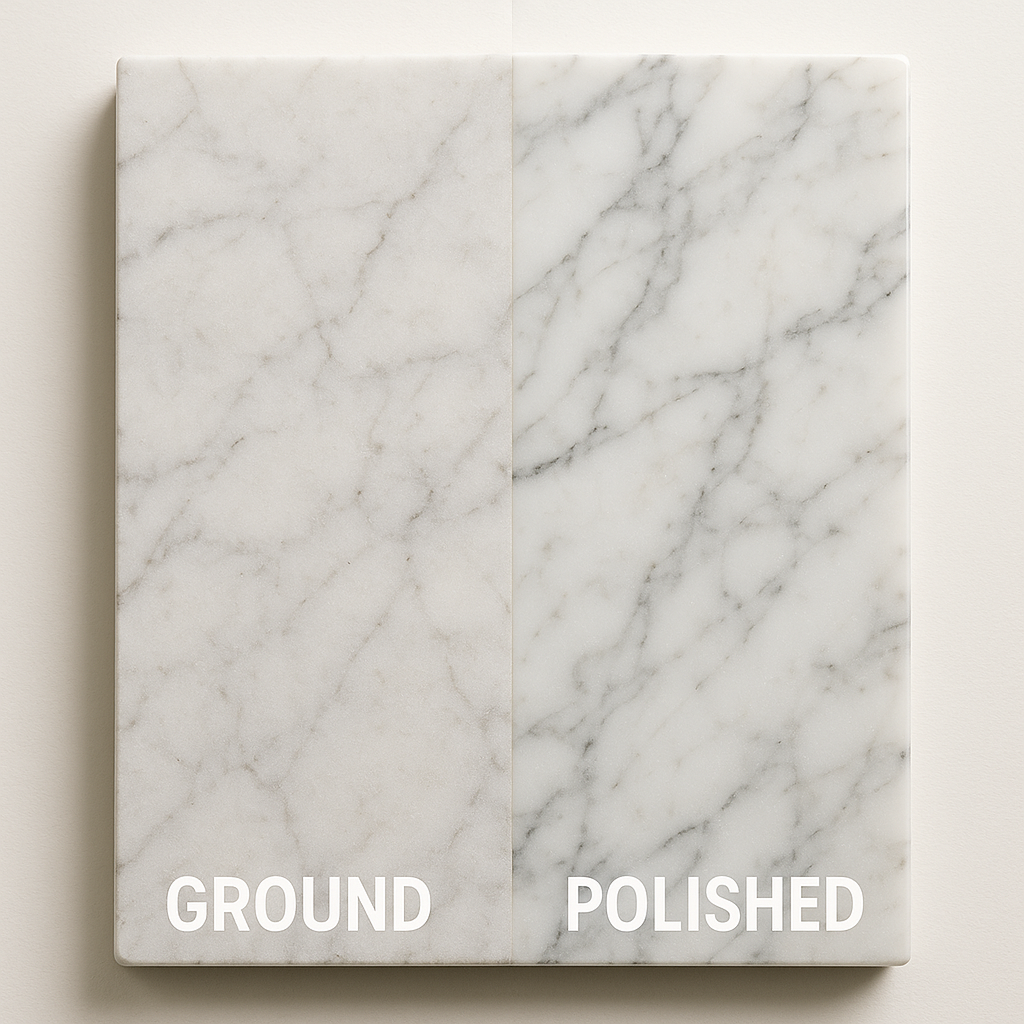
The Difference Between Grinding and Polishing Natural Stone
Grinding and polishing are often used interchangeably, but they are two very different processes with different goals and different results.
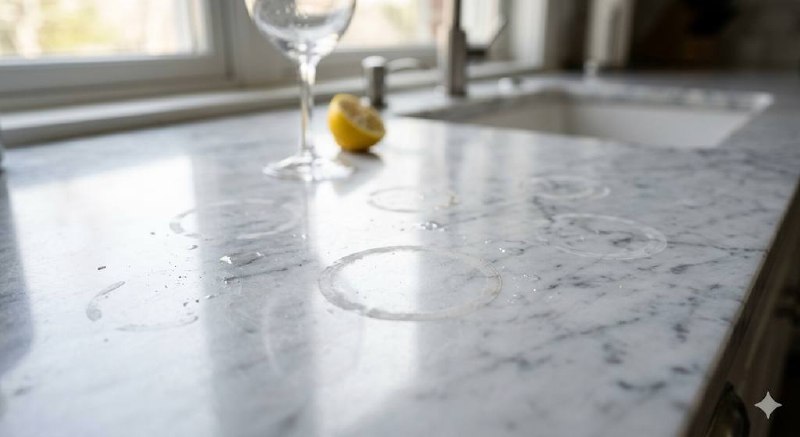
Etching on Marble: What It Is, How It Happens and How to Prevent It
Etching is the most common damage to marble floors and worktops. Learn what it is, what causes it, what you can do yourself and when to call a specialist.
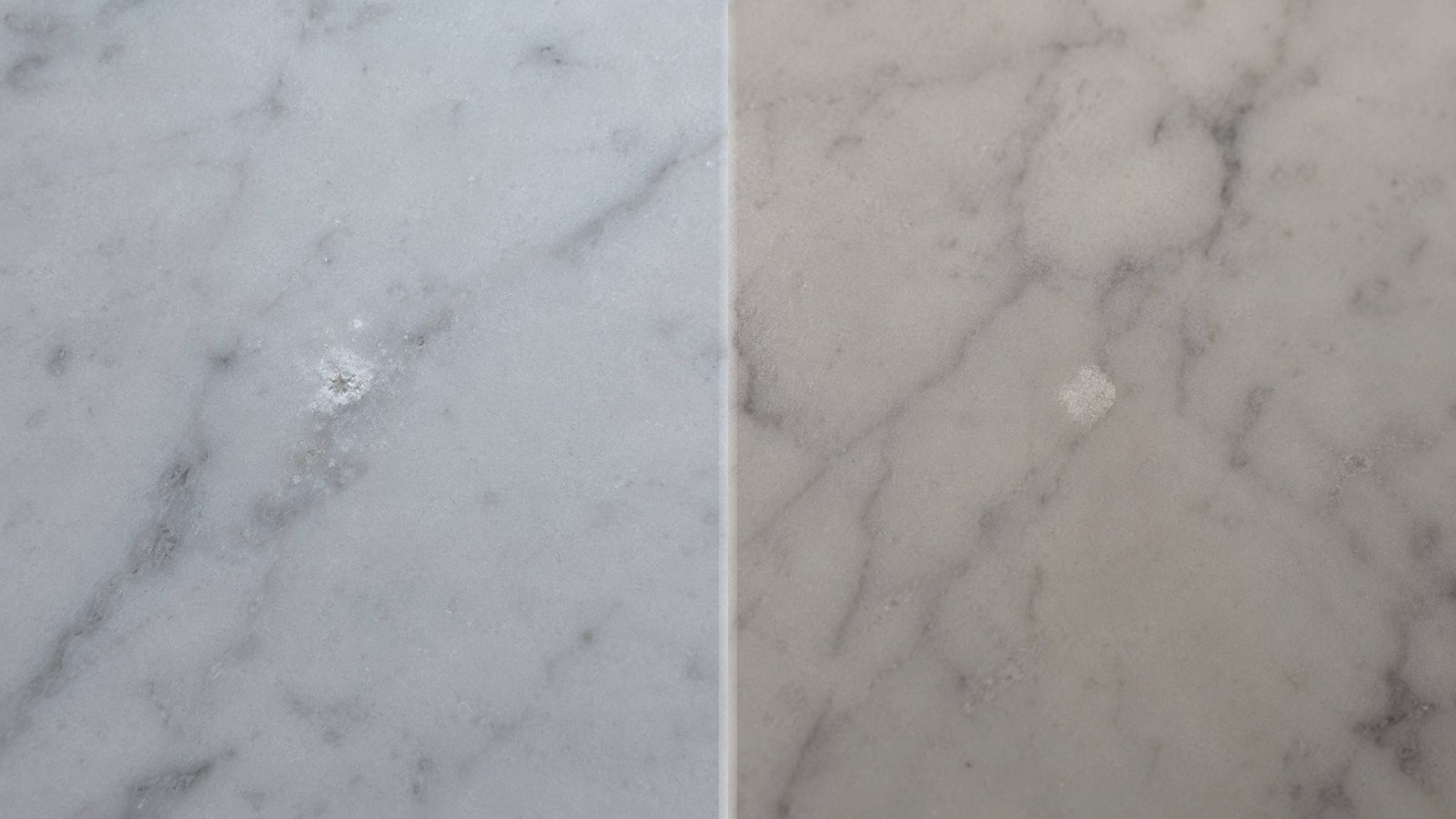
Impact Bruising in Marble: White Marks from Impact or Point Load
A light or white mark in marble after an impact is often not an ordinary stain, but impact bruising: broken crystals caused by impact or point load.