Cracks in Natural Stone: Causes, Types and Repair Options
A crack in natural stone does not have to mean the end of the surface. Learn to recognise different crack types, understand what causes them and discover which repairs are realistic.
DecoStone Natural Stone
Natural stone specialist · Amsterdam
Table of contents
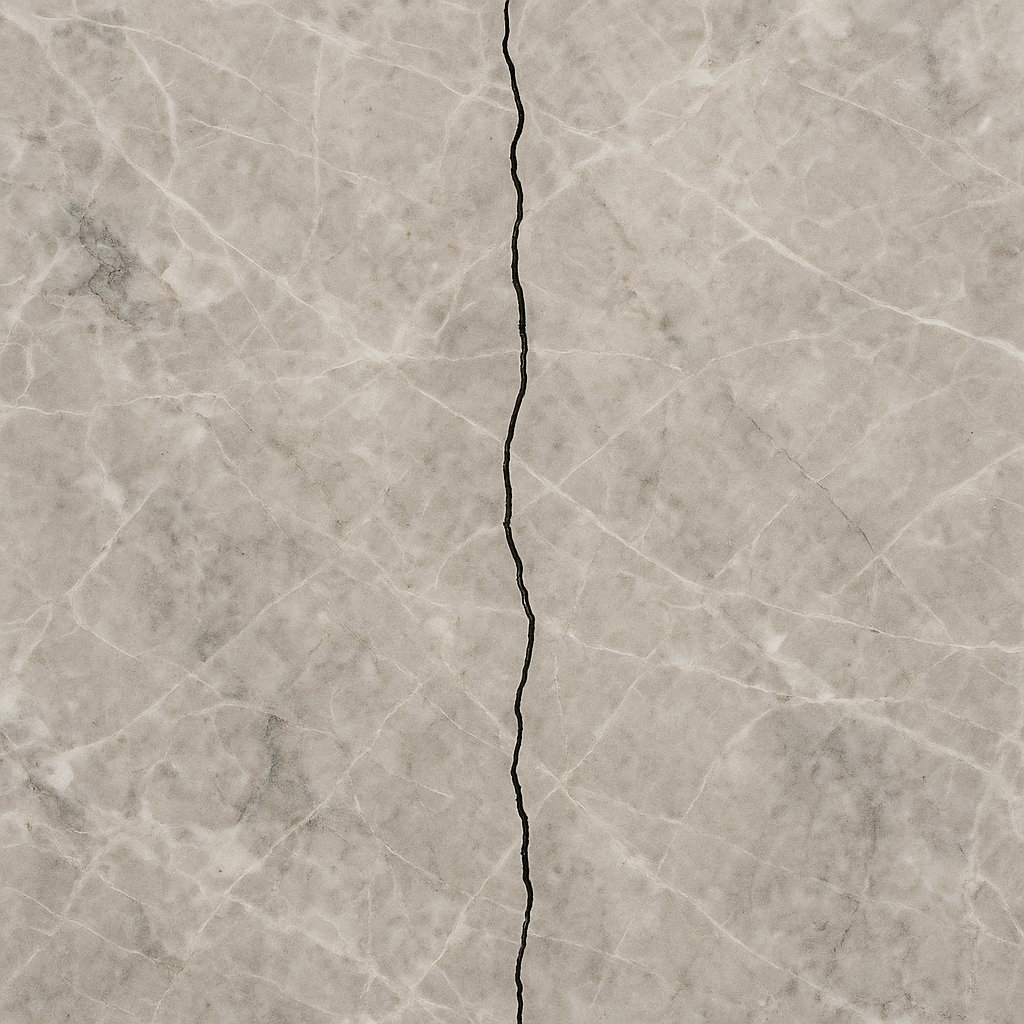
Not every crack is the same
When you discover a crack in a natural-stone floor or façade, you immediately want to know: is this serious? Can it still be repaired? And what caused it?
The honest answers: it depends. Some cracks are purely cosmetic and can be dealt with in an afternoon. Others point to an underlying problem that will only become larger and more expensive if ignored. The difference lies in the type of crack, the stone type and the cause.
Types of cracks: recognise what you are dealing with
Hairline cracks
Fine, superficial cracks that are barely visible unless light falls across the surface at an angle. They are only in the top layer of the stone and have no structural significance.
Causes: thermal stress, incorrect sanding or polishing, cleaning too aggressively with acids. Hairline cracks in marble are sometimes already present in the stone itself — we call this the vein or crystal structure of the stone.
Repair: polishing or filling with clear stone adhesive. Simple and usually very repairable.
Through-cracks
The crack runs through the entire tile or panel, from top to bottom. You can usually feel this if you run a fingernail over the stone.
Causes: shrinkage or expansion of the substrate, overloading (a heavy object falling), uneven settlement of the floor.
Repair: depends on the cause. If the substrate is stable, the crack can be filled with colour-matched epoxy resin. If the substrate is still moving, repair is pointless until that movement has been resolved.
Fracture cracks
The tile has broken into two or more pieces but is still in place. This is often seen in thinner tiles on a floor with slight settlement.
Repair: if the pieces are complete and the substrate is stable, they can be bonded with specialist stone adhesive and epoxy. The result is functionally sound, but the crack will remain visible to a greater or lesser degree depending on the stone type.
Structural cracks in façades or worktops
Cracks in façade cladding or worktops that become larger or form a pattern. This is the category that requires immediate attention.
Repair: requires a thorough inspection of the fixing method, substructure and expansion joints. Sometimes replacing a panel is the only responsible option.
What causes cracks?
Thermal stress
Stone expands with heat and contracts in cold conditions. In a properly designed floor or façade, expansion joints are used to absorb that movement. If those joints are missing or blocked, stress builds up until something gives — and that is often the stone.
This is by far the most common cause of cracks in outdoor floors and façades.
Settlement of the substrate
Every substrate settles over time. A crawl space that dries out, a base layer that was compacted unevenly, or simply an old building finding its own way. If the floor moves and the stone cannot move with it, it cracks.
Mechanical overload
Heavy equipment, a move with a pallet truck, or a heavy pan falling onto a thin slab. Marble and calcareous sandstone are harder than they look, but also more prone to fracture than many people expect.
Design or installation errors
An adhesive bed that is not fully compressed (a hollow spot), insufficient joint width, no screed with sufficient tensile strength. Installation errors often only become visible years later.
Frost damage
Water in the pores of the stone freezes and expands. This causes flaking and hairline cracking at the surface. Sandstone and untreated limestone used outdoors are particularly vulnerable.
Repair strategies
Epoxy injection
For through-cracks or loose tiles, liquid epoxy is injected into the crack through small drill holes. The epoxy bonds stone to stone and to the substrate. This works very well if the cause has been removed.
There is a downside: epoxy is harder than most natural stones. With long-term or repeated movement in the substrate, the stone can crack again next to the repair.
Stone adhesive and colour pigments
For superficial cracks and hairline cracks. The crack is filled with a low-viscosity adhesive and then coloured with stone pigments. On marble floors and granite worktops, this can give an excellent result.
Replacement
Sometimes the tile is too badly damaged for an acceptable repair, or the crack is the result of a structural problem that guarantees recurrence. In those cases, replacement is the fairest option. We always advise keeping spare tiles after installation — only after 15 to 20 years do you realise how useful that can be.
Cosmetic repair
For situations where an invisible repair is not essential but functionality must be restored: sealant filling in a colour that matches the stone. It is quick, inexpensive and requires no specialist equipment. The crack remains slightly visible but is functionally sealed.
Warning: repair does not remove the cause
This may be the most important thing to understand about cracks in natural stone.
Closing a crack treats the symptom. If the construction beneath the stone continues to move — settlement, thermal stress, moisture, an unstable screed — the crack will return. Sometimes in the same place, sometimes next to it. We can repair the crack, but if the cause is not addressed, it is only a matter of time before you call again.
More about natural stone with underfloor heating: what you need to know
We do not say this to discourage repair. Sometimes it is simply sensible to cosmetically repair a stable situation. But we are honest: if there is movement in the substrate, missing expansion joints or moisture damage, we discuss that first. A repair that has to be repeated in two years benefits nobody.
When to call a specialist immediately
- The crack becomes larger or deeper over time
- The tile cracks again after a previous repair
- You hear the floor “ticking” or feel movement
- Several tiles have cracks in the same area
- It concerns façade cladding above a public area or passageway
These are signs that something is happening below the surface. Delaying action almost always leads to greater damage and higher costs.
Prevention: avoiding cracks
- Provide sufficient expansion joints, especially with outdoor floors and large surfaces
- Have natural stone installed on a full, hollow-free adhesive bed
- Impregnate outdoor stone to reduce frost damage
- Do not remove flexible sealant joints, and renew them in good time
- Do not use acidic cleaners on sensitive stone types
Do you have cracks in your natural-stone floor or façade and are you unsure of the cause? Send us a photo — we will be happy to look with you and give honest advice on the best approach.
Need help?
Are you unsure about the right approach, or would you like to know what is possible? Send a photo via WhatsApp and we will give you honest advice — without obligation.
Want to be sure which treatment is safe?
Send photos of the surface, room and problem. DecoStone assesses the material, damage pattern and risks before advising on a treatment or quotation.
Related articles
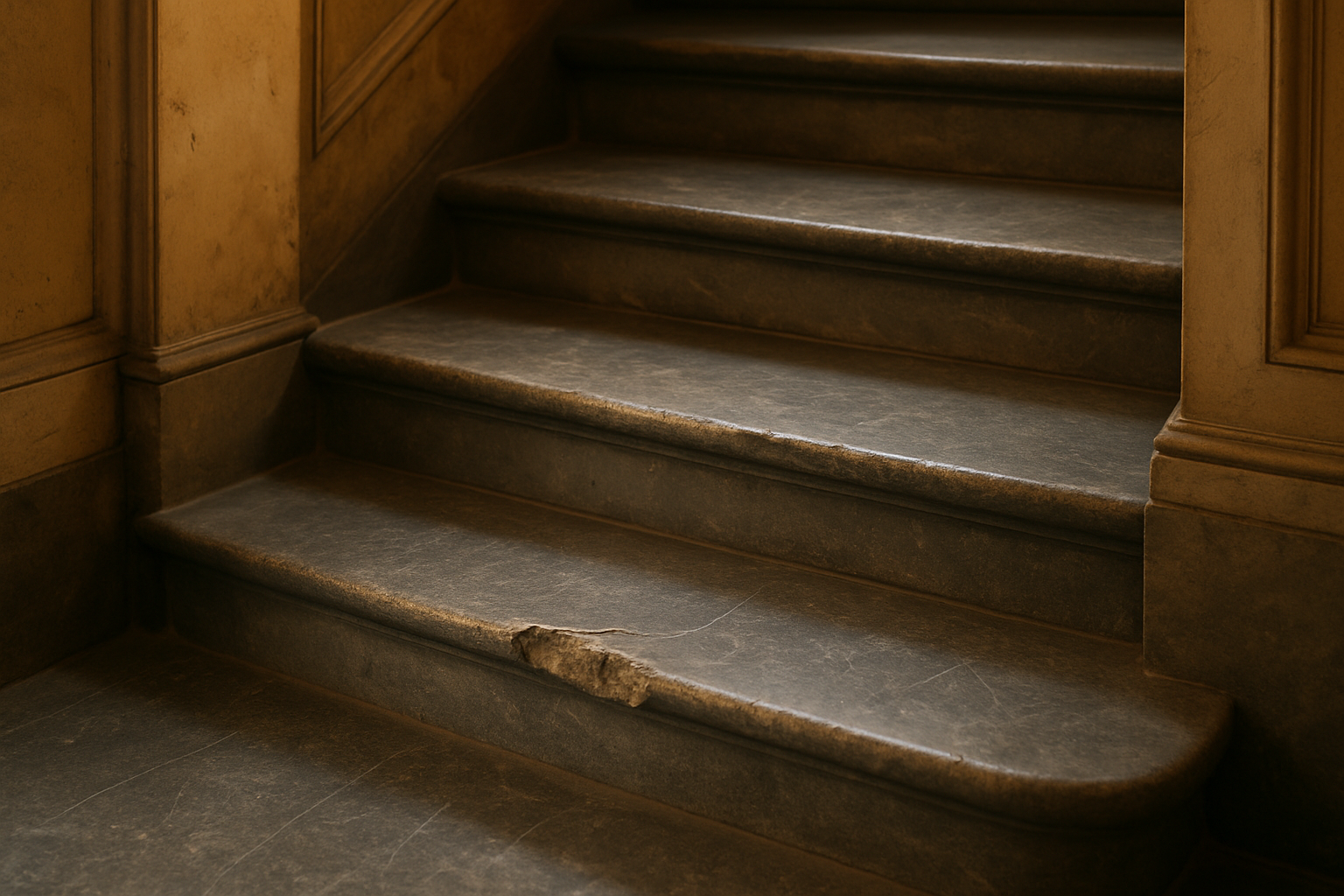
Repairing Damaged Natural Stone Stair Treads
Crumbled corners, deep wear, cracks or loose treads: damaged natural stone stair treads can often be repaired. But there are limits.
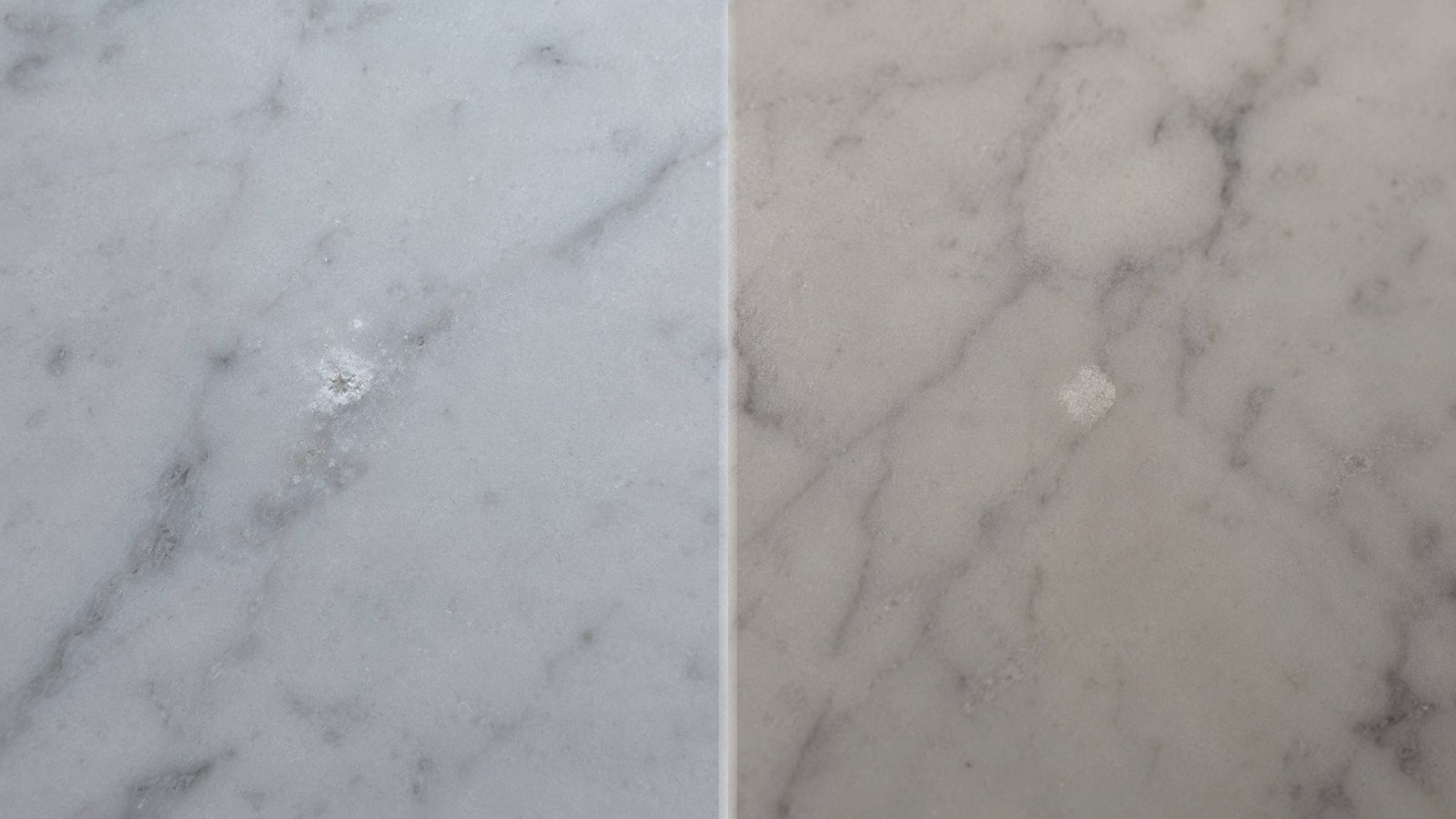
Impact Bruising in Marble: White Marks from Impact or Point Load
A light or white mark in marble after an impact is often not an ordinary stain, but impact bruising: broken crystals caused by impact or point load.
Marks and Polishing Bands in Taj Mahal Quartzite: What Repair Is Realistic?
Taj Mahal quartzite is hard, light-coloured and valuable. Marks or polishing bands after installation are difficult to correct. Read what makes repair realistic and when inspection should come first.