Repairing Damaged Natural Stone Stair Treads
Crumbled corners, deep wear, cracks or loose treads: damaged natural stone stair treads can often be repaired. But there are limits.
DecoStone Natural Stone
Natural stone specialist · Amsterdam
Table of contents
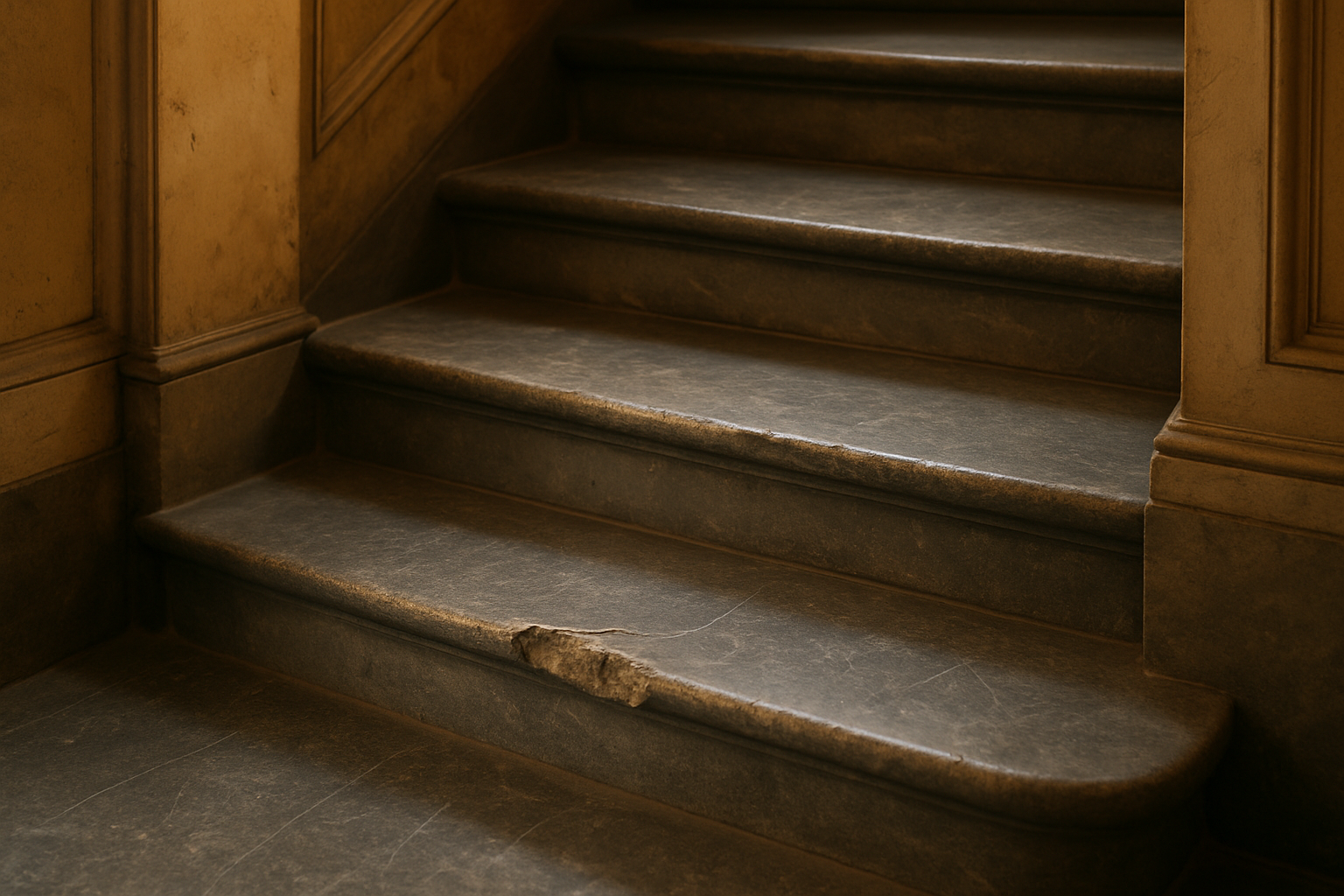
The stair tread: the hardest-working piece of stone in the building
Nowhere in a home or building does a stone surface have to work harder than on a stair tread. For years, the same spot is stepped on, with the nosing taking the most impact. Shoe soles, rolling suitcases, moving boxes, high heels — the tread has to absorb all of it.
It is therefore no surprise that stair treads are among the most commonly repaired elements in our work. Almost always, something can be done. But "something" is not the same as "as good as new". It is important to be honest about what is and is not achievable.
Common damage to stair treads
Wear on the nosing
The nosing of the tread — the projecting front edge — wears fastest. On bluestone outdoor stairs and marble indoor stairs in older buildings, you often see a clear hollow in the middle, exactly where most feet pass.
Light wear can be repaired well by sanding. Deep hollows are more difficult: a lot of material has to be removed to restore flatness, and with thin treads that is not always responsible.
Read the difference between sanding and polishing natural stone
Crumbled corners and nosings
A falling object, a knock from a moving box, a metal edge that is removed: the nosing can crumble. Sometimes it is a small piece, sometimes several centimetres.
Small areas are repaired with stone filler: a mixture of stone dust, binder and pigment that is cured and then sanded and colour-adjusted. When done well, the result is almost invisible on coarse-grained stone types. On polished white marble or monochrome bluestone, the repair line will always remain visible to some extent when light falls across it.
Large pieces that have been saved can be reattached with stone adhesive.
Cracks
See also our article about cracking. On stair treads, cracks are usually the result of mechanical impact, thermal stress or movement in the support.
Important: a crack in a stair tread is not only an aesthetic problem. If the crack runs across the nosing or diagonally through the width of the tread, there is also a safety risk. A tread that cracks further or breaks under load is dangerous. Prompt action is necessary.
Loose treads
A tread that moves when you stand on it is dangerous. The cause is almost always a failure in the bond: the adhesive layer has let go, the screed underneath has moved, or the original installation was insufficient.
Repair does not remove the cause
This applies to stair treads as well.
Re-bonding a loose tread makes sense if the support is stable. But if the staircase itself moves — if there is play in the suspension, if a supporting beam is rotten or if the screed is no longer in place — then bonding is only a patch over the problem.
We always first check whether the staircase is structurally sound. Only then does it make sense to treat the stone. If that is not addressed, it is only a matter of time before the damage returns.
Repair strategies
Sanding and refreshing
For wear and small superficial damage, the tread is sanded on site with portable sanding equipment. This works very well on bluestone, granite and marble treads with a flat profile.
Result: an even, fresh surface. The tread looks good again. Any minor wear in the centre is removed or significantly reduced by sanding.
Rebuilding the nosing with stone filler
This is the most common repair technique for stair treads. The crumbled area is milled or cleaned, then built up with several layers of filler, cured, sanded and colour-adjusted.
The quality of the result depends strongly on the colour work. Marble treads with rich veining are more difficult to match than an even grey granite.
Full replacement of the tread
Sometimes the damage is too extensive for a meaningful repair. A tread that is broken in several places, internally loose, or missing a large part of its nosing is often better replaced.
Replacement is also the right choice when the damage is structural rather than cosmetic.
When replacing, we always advise keeping the original tread if possible. In listed or historic buildings, reusing or accurately reproducing the original can be a requirement.
Outdoor steps: additional points of attention
Outdoor steps are exposed to rain, frost and biological growth, on top of the mechanical load.
Read how to prepare outdoor natural stone for winter
Pay attention to the following with outdoor steps:
- Anti-slip: a polished or smooth outdoor step is a safety risk. After repair or renovation, a flamed, sawn or anti-slip-treated surface can be applied.
- Impregnation: outdoor stone must be protected against moisture absorption, otherwise frost damage remains a constant risk.
- Fall: water must be able to drain off the step. If the tread is completely level and water remains standing, frost damage is highly likely.
Costs
The cost of repairing stair treads depends strongly on the extent of the damage and the number of treads. A single repair to a crumbled nosing costs considerably less than sanding and repairing an entire stairwell.
We always provide a fixed price per tread, so you know exactly where you stand.
Do you have damaged stair treads and want to know whether repair is feasible? Send a photo of the damage and we will give you a direct, honest assessment.
Need help?
Unsure about the right approach, or want to know what is possible? Send a photo via WhatsApp and we will give you honest advice — without obligation.
Want to be sure which treatment is safe?
Send photos of the surface, room and problem. DecoStone assesses the material, damage pattern and risks before advising on a treatment or quotation.
Related articles
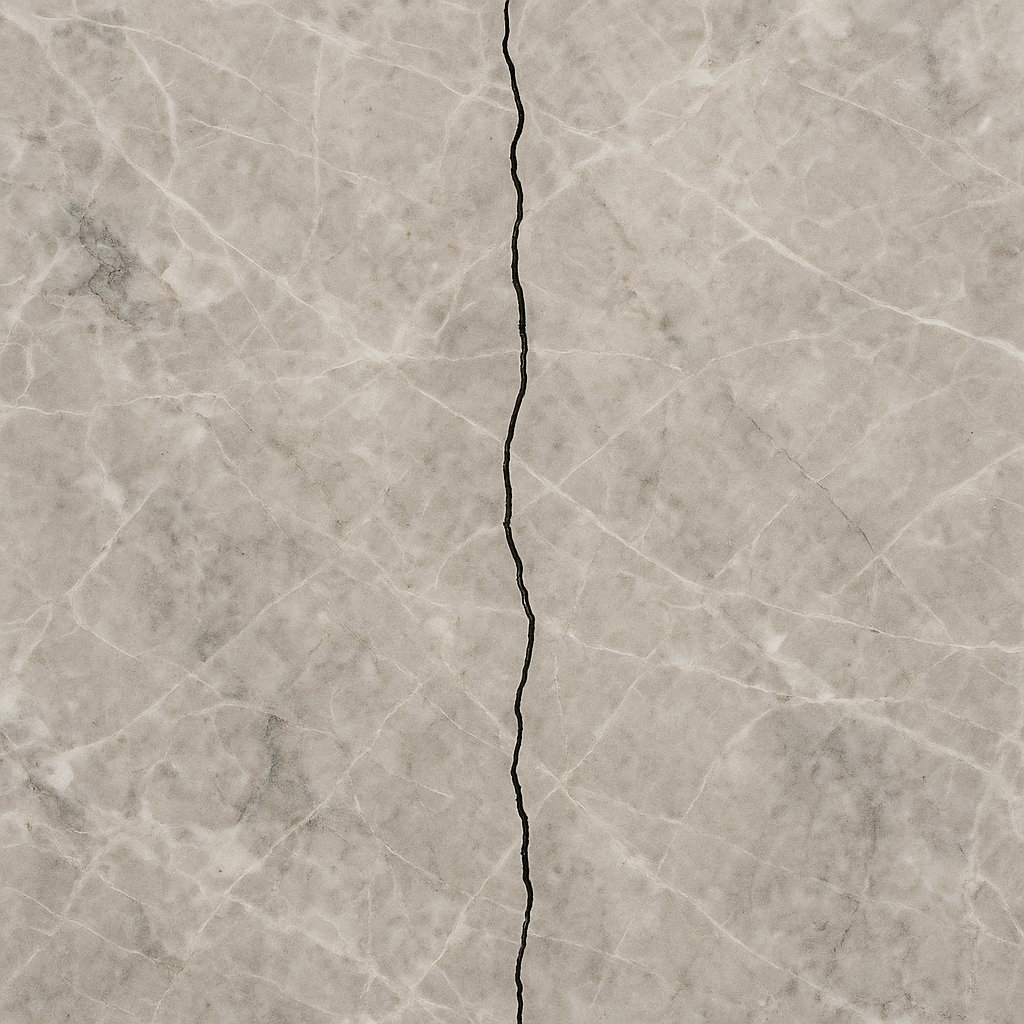
Cracks in Natural Stone: Causes, Types and Repair Options
A crack in natural stone does not have to mean the end of the surface. Learn to recognise different crack types, understand what causes them and discover which repairs are realistic.
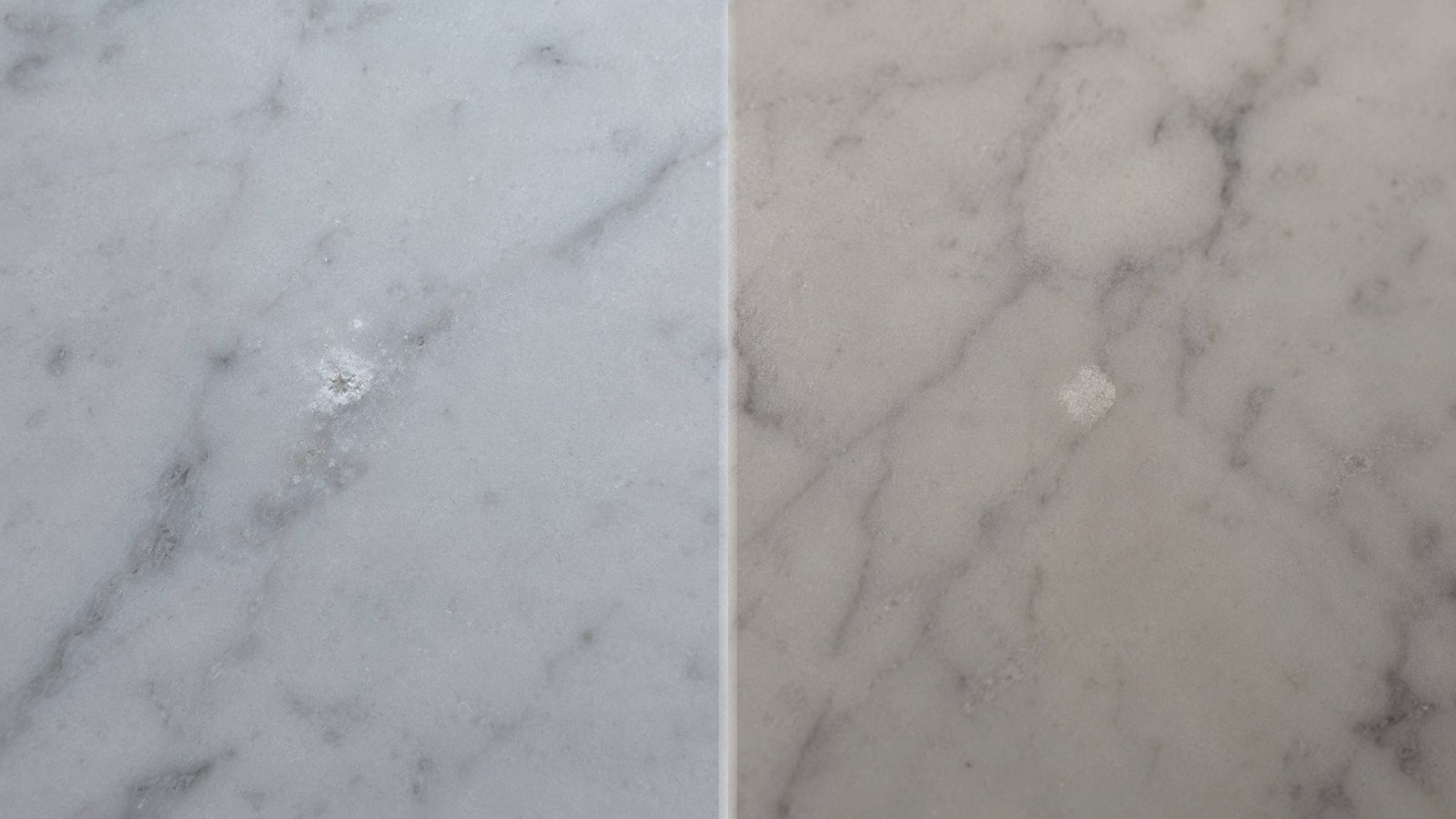
Impact Bruising in Marble: White Marks from Impact or Point Load
A light or white mark in marble after an impact is often not an ordinary stain, but impact bruising: broken crystals caused by impact or point load.
Marks and Polishing Bands in Taj Mahal Quartzite: What Repair Is Realistic?
Taj Mahal quartzite is hard, light-coloured and valuable. Marks or polishing bands after installation are difficult to correct. Read what makes repair realistic and when inspection should come first.