Granito and Terrazzo: Maintenance, Grinding Hollows and What to Know Before Treatment
Granito and terrazzo are beautiful craft floors, but they have their own quirks. Learn about dry grinding, grinding marks, gloss levels and realistic expectations.
DecoStone Natuursteen
Natural stone specialist · Amsterdam
Table of contents
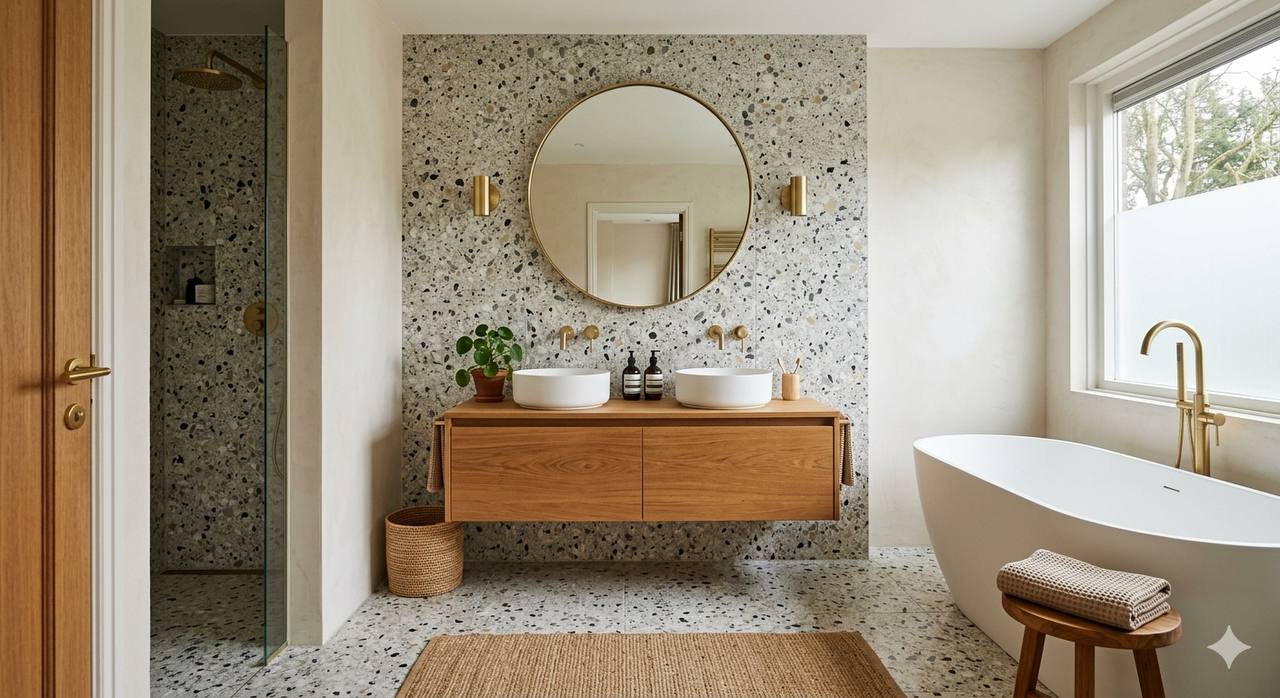
Granito and terrazzo: the same material, two names
Granito and terrazzo are often used interchangeably. Both refer to the same type of floor: a composite of cement plaster (or sometimes resin) containing fragments of natural stone, marble, glass or shell. The fragments are scattered into the wet cement layer, pressed in and ground flat after curing.
The difference is tradition and region. In the Netherlands people usually say granito; in Italy and internationally, terrazzo. The material, technique and challenges are the same.
Granito is common in pre-war and post-war homes, schools, hospitals and public buildings. Many of these floors are decades old and, despite neglect, still have a sound base.
How granito is traditionally made
A terrazzo installer applies a cement-bound mortar layer to the subfloor. Stone fragments are scattered into the still-wet mortar — their size, colour and density determine the final appearance. After curing, the surface is ground until the stone fragments become visible and the whole surface feels flat.
This is where there is a crucial difference from natural-stone finishing.
Dry grinding versus wet grinding
Natural-stone specialists grind with water. The water cools the diamond disc, removes grinding dust and creates an even contact surface. The result is usually uniform.
Terrazzo workers traditionally grind dry. There are historical and practical reasons for this: during installation, the cement-bound floor must be finished quickly, and wet working slows the process. Dry grinding is faster, but it has a consequence that only becomes visible later.
Grinding hollows and undulations
During dry grinding, the machine does not apply equal pressure everywhere. The edge of the grinding disc presses differently from the centre. Some zones receive more passes than others. The result: the surface looks flat, but it contains subtle undulations — microscopic hollows and rises in the surface.
With a matt finish this is barely visible, if at all. The surface feels smooth and looks good.
But as soon as you increase the gloss level, it becomes visible.
Why higher gloss shows more unevenness
This is the most important thing to know as the owner of a granito floor.
Test it yourself: take a damp cloth and wipe one corner of your granito floor. The wet patch temporarily has more shine than the dry surroundings. In that moment of gloss, you suddenly see irregularities you did not notice when dry: breaks in the reflection, matt spots, slight depressions.
Those are the grinding hollows from the original dry grinding. They were always there — you simply did not see them because the low gloss concealed them.
What this means for treatment:
If you have a granito floor honed or polished, you increase the gloss level. With that higher gloss, the undulations from the original installation become more visible. This is not an error by the contractor. It is a property of the material and the way it was once laid and ground.
Making a granito floor completely even — without any undulation — would mean re-flattening the entire surface with wet diamond grinding. That is possible, but considerably more expensive and intensive than a standard refresh.
What can you realistically expect?
With honing (satin gloss)
- A beautiful, warm satin sheen
- Colours become more intense
- The floor feels smoother
- Grinding hollows become slightly more visible, but usually not distracting overall
- This is the most commonly chosen option for granito floors
With polishing (high gloss)
- Mirror-like reflection
- Colours at their richest
- Grinding hollows become clearly visible in raking light or when the surface is wet
- Suitable if you accept the character of the floor, including its craft imperfections
- Less suitable if you expect a perfectly even mirror
With flattening + honing/polishing
- The entire surface is re-flattened using wet diamond techniques
- Grinding hollows are largely eliminated
- Considerably more intensive and expensive
- The best result when budget and time allow
Daily maintenance of granito
Granito is robust. The cement-bound matrix is hard, durable and resistant to most everyday loads. Maintenance is simple if you follow a few rules.
Daily
- Vacuum or sweep dry before wet cleaning. Sand and grit are the main enemies — they create scratches that reduce gloss over time.
- Damp mop with a well-wrung mop and a pH-neutral stone cleaner. Do not flood the floor — granito absorbs moisture through micropores and joints.
- No vinegar, cleaning vinegar or all-purpose cleaner. The cement matrix is sensitive to acidic products. Repeated use of acidic cleaners attacks the binder.
Weekly to monthly
- Check the joints. In granito, joints are often less visible than in tiles, but they do wear. Damaged joints allow moisture under the floor.
- Remove stains immediately. Coffee, wine and oil penetrate if the floor is not impregnated.
Impregnating granito
Granito has pores — fewer than limestone, more than granite. Without impregnation, liquids soak in and stains form.
When?
- After every grinding or polishing treatment
- If the water test fails: place a drop of water on the floor — if it soaks in, retreatment is needed
- Usually every 1–3 years, depending on use
Which product?
- BioShield or a comparable solvent-free impregnator suitable for cement-bound stone
- No oil-based impregnators — they can discolour lighter stone fragments
- No topcoats or lacquers — they eventually flake
How?
- Clean the floor thoroughly and let it dry completely (24 hours)
- Apply the impregnator with a soft brush or cloth
- Allow 5–10 minutes to penetrate
- Remove excess product before it dries
- Allow 24 hours drying time before normal use
Common problems with granito floors
White bloom (efflorescence)
Salts from the cement layer or subfloor migrate to the surface and form a white haze. This points to moisture problems under the floor. The bloom itself can be removed, but the source — moisture — must be addressed.
Loose fragments
In old granito floors, the cement matrix around individual stone pieces can weaken. The fragments come loose and leave a void. This can be repaired with matching stone adhesive or terrazzo repair mortar, but invisible repair requires skill.
Cracks
Granito does not have joints or movement gaps in the same way as tiled work. Settlement of the building or thermal movement can cause cracks. Small cracks can be repaired cosmetically. Structural cracks point to an underlying problem.
Paint traces and coatings
Many granito floors in old homes were once painted or given a synthetic coating. Removing this without damaging the stone is labour-intensive. Laser cleaning can be a solution.
Granito versus natural stone: what is the difference?
| Granito/Terrazzo | Natural stone | |
|---|---|---|
| Composition | Cement + stone fragments (man-made composite) | Solid rock from nature |
| Hardness | Variable, depending on binder and fragments | Depends on type (marble soft, granite hard) |
| Acid sensitivity | Moderate — cement matrix is sensitive | Highly variable by stone type |
| Traditional grinding method | Dry (terrazzo workers) | Wet (natural-stone specialists) |
| Grinding hollows | Often present because of dry grinding | Less common because of wet technique |
| Repair | Add mortar + stone fragments | Grinding/polishing or stone adhesive |
When should you call in a specialist?
- The floor is dull and worn but the base is intact → honing + impregnation
- You want maximum gloss and accept that grinding hollows become more visible → polishing + impregnation
- You want the most even result possible → flattening + honing/polishing (discuss expectations beforehand)
- Loose fragments or cracks → repair + treatment — read more about cracks in natural stone
- Old paint or coating removal → laser cleaning or chemical removal — more about laser cleaning natural stone
- White bloom that keeps returning → moisture diagnosis + treatment — read all about white bloom on natural stone
DecoStone treats granito floors and terrazzo with the same precision as solid natural stone. We always discuss in advance what is realistically achievable — including the story about grinding hollows. No surprises afterwards.
Do you have a granito floor that needs refreshing? We are happy to visit for a no-obligation assessment.
Need help?
Unsure about the right approach, or want to know what is possible? Send us a photo via WhatsApp and we will give you honest advice — without obligation.
Want to be sure which treatment is safe?
Send photos of the surface, room and problem. DecoStone assesses the material, damage pattern and risks before advising on a treatment or quotation.
Related articles
The Lime Soap Method for Antique Floors: What It Is and When to Use It
Lime soap is a traditional method for cleaning and protecting antique natural stone floors. It is not suitable for everything, but works well on the right floor.
Slate Maintenance: Oil or Impregnate — Which Works Better?
Slate needs a different approach from marble or bluestone. Oiling and impregnation each give a different result. What you choose depends on the application.
Preparing Outdoor Natural Stone for Winter: What Works and What Does Not
Frost damage to slate terraces, bluestone or limestone paving can often be prevented. But not with every product, and not always completely. An honest guide.