Marble in the Bathroom: What Goes Wrong and How to Prevent It
Marble in the bathroom is beautiful, but it requires specific knowledge. These are the most common mistakes in installation, cleaning and maintenance — and how to avoid them.
DecoStone Natural Stone
Natural stone specialist · Amsterdam
Table of contents
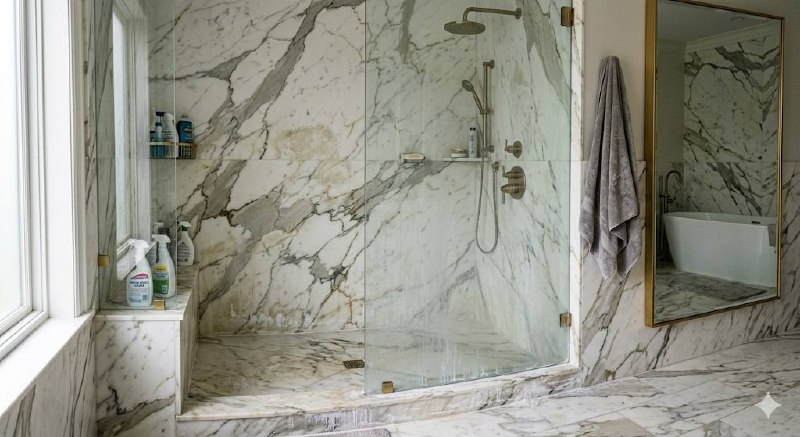
Marble in the bathroom: beautiful and demanding
Marble in the bathroom stands for timeless luxury. Whether it is a large Bianco Carrara floor, a Nero Marquina shower or a veined vanity top, the material exudes class. That is exactly why so many people choose it — and also why so many people end up disappointed.
Technically, a bathroom is a difficult environment for marble: constant moisture, soap, shampoo, hard tap water and cleaning products that are often aggressive by definition. If that is not understood, stains, limescale, etching and discolouration soon follow.
This article goes through the most common mistakes so you can avoid them.
Mistake 1: Using standard bathroom cleaner
This is the biggest and most common mistake. Almost all bathroom sprays, tile cleaners and limescale removers are acidic — exactly what damages marble.
Marble consists of calcite. Acid dissolves calcite. You see the result as matte, dull areas on an otherwise glossy surface: etching. Etching is not a stain you can wipe away. It is surface damage that requires professional polishing.
What you should use:
- Clean warm water with a soft microfibre cloth
- A pH-neutral stone cleaner (specifically labelled as suitable for marble and limestone)
- For limescale: a special descaler for natural stone — never vinegar or standard descaler
Good brands: Lithofin Easy Care, Fila Cleaner, BioShield Stone Cleaner.
Mistake 2: Impregnating the stone before it is completely dry
After marble tiles are installed, the stone needs time to dry fully. The mortar and grout contain water that evaporates slowly. If you impregnate too soon, you "seal" the stone while moisture is still inside. This can cause white deposits (efflorescence), or the impregnator may simply not work properly because the pores are already filled with water.
Minimum waiting time: 48–72 hours after grouting for a newly installed floor or wall, in a well-ventilated room. With thick mortar beds or poorly ventilated bathrooms, wait even longer.
Not sure? Do the water absorption test: place a drop of water on the stone. Does it soak in quickly? Then the stone is dry enough for impregnation.
More about impregnation: When should you have your natural stone impregnated?
Mistake 3: Incorrect grout or poorly finished connections
Marble in a wet room requires water-resistant joints in the right places. The most vulnerable areas are:
- Transition between floor and wall (corner joint)
- Transition between shower and vanity
- Connections around taps and drains
If the connection comes loose or the silicone sealant cracks, water penetrates behind the stone. This leads to:
- Loose tiles
- Mould growth behind the stone
- White deposits on the front
- In more serious cases: structural moisture damage in the wall or floor
Correct approach: All transitions from stone to other materials are finished with flexible silicone sealant (not rigid grout). This accommodates movement and remains watertight.
Check every year whether the sealant is intact. At the first crack, replace it immediately.
Mistake 4: Too little ventilation
A bathroom where steam hangs around for hours is challenging for any stone. Limescale builds up faster, damp pores remain filled, and the impregnator is less effective.
Good ventilation (mechanical or through a window) that continues for at least 30 minutes after showering significantly extends the life of your marble bathroom.
Mistake 5: Soap dishes and shampoo bottles placed directly on the stone
Soap and shampoo can have a pH value outside the neutral range. Small splashes and drips along the side of the bottle are in constant contact with the stone. Over weeks and months, this creates marks.
Solution: Use a coaster or tray under all products. Where possible, hang products in wall-mounted holders so they do not stand on the stone. Wipe shower walls after use with a squeegee; this removes soapy water and greatly reduces limescale.
Mistake 6: Too large an area without an expansion joint
Large marble bathroom floors with underfloor heating need room to move. Marble expands and contracts slightly with temperature changes. Without expansion joints (movement joints at the edges and in larger areas), the stone can tent or crack.
If you are installing a floor with underfloor heating, always discuss the required expansion joints with the tiler. More on this in our article Natural stone with underfloor heating.
Mistake 7: No or insufficient fine grouting with small formats
Marble mosaics and small formats are sometimes installed with minimal joints "for a sleek result". But narrow joints in wet marble applications are a risk factor: moisture has little room to escape, soap accumulates more easily in the joint and mould develops faster.
Minimum joint width for natural stone in wet rooms: 2–3 mm. Use a grout system with fungicidal additives or an epoxy grout for high water resistance.
Mistake 8: Using the same marble on floor and wall without considering slip resistance
Polished marble is beautiful. On a wall. On a wet floor, polished marble is dangerously slippery. The floor finish must always meet slip-resistance values (R9 or higher for wet indoor rooms, R11 or higher outdoors).
Options for a marble floor in a shower or bathroom:
- Brushed (honed) surface
- Matte finish
- Subtle relief from light texturing
- Small formats with many joints (more grip from the joint pattern)
When should you call in a specialist?
Most bathroom damage to marble can be prevented. But if something does go wrong, do not wait:
- Matte spots that cannot be cleaned → professional polishing
- Mould behind joints → open the joints, remove the cause, then regrout
- Etching over large areas → polishing treatment by DecoStone
- Loose tiles → treat as soon as possible before water infiltration progresses
Need help? Contact DecoStone →
See also: Etching on marble: what it is and how to prevent it
Need help?
Not sure about the right approach, or would you like to know what is possible? Send us a photo via WhatsApp and we will give you honest advice — without obligation.
Want to be sure which treatment is safe?
Send photos of the surface, room and problem. DecoStone assesses the material, damage pattern and risks before advising on a treatment or quotation.
Related articles
Importing Natural Stone? Check Quality Control Before Handover
Importing natural stone yourself, or having it supplied through several parties, can work well, but it requires proper quality control. Especially with quartzite such as Taj Mahal, repair costs after installation can rise sharply.
Preparing for the Workday: How to Be Ready for DecoStone
DecoStone will soon visit for maintenance, repair, polishing or impregnation of natural stone. With this preparation, the workday can run calmly, neatly and efficiently.
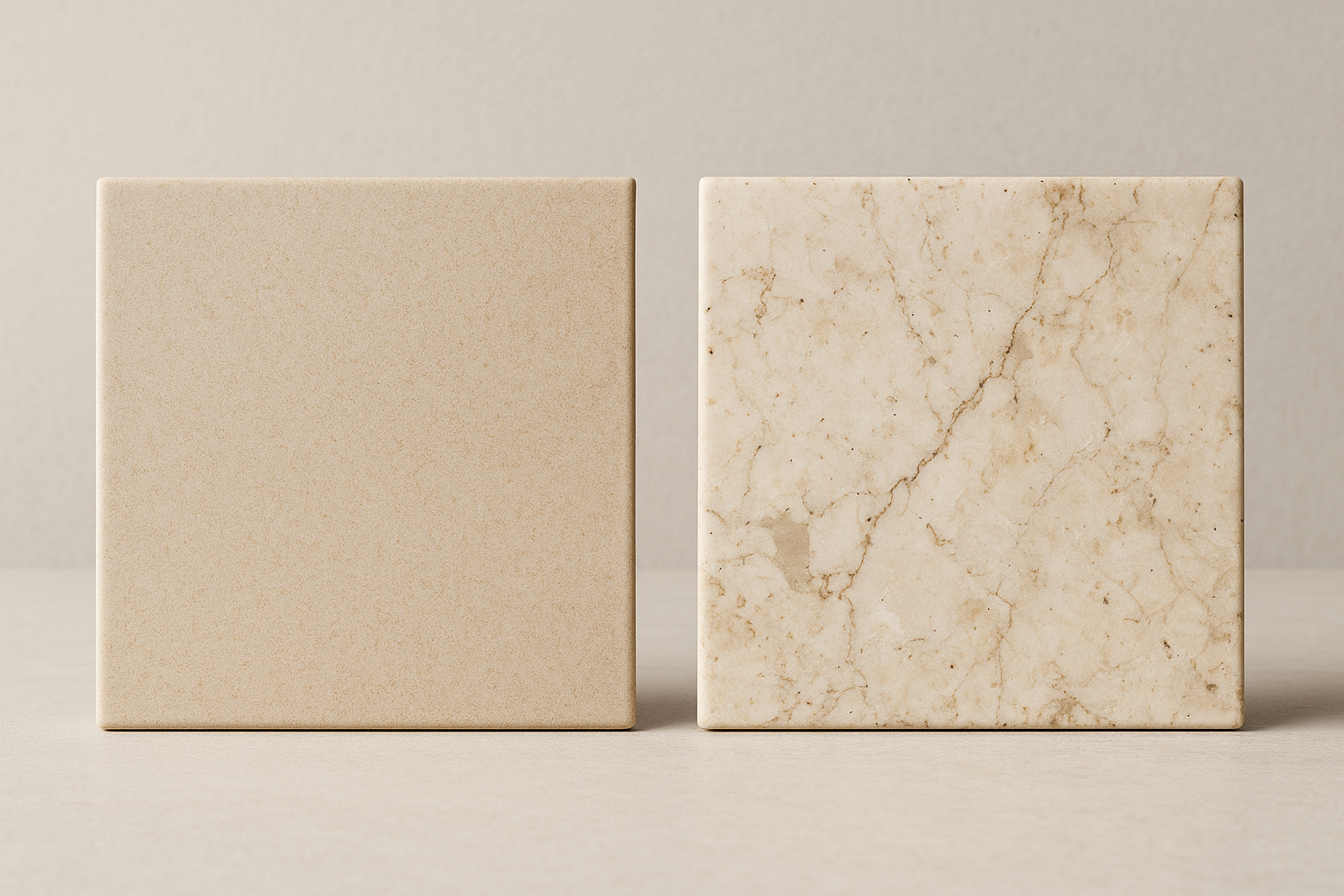
Ceramic vs. Real Natural Stone: An Honest Comparison
Ceramic tiles imitate stone better and better. But there are essential differences that only become visible after years — or sooner than expected. What should you consider?